
You may be an operations manager scoping a storage or fulfillment upgrade, a controls engineer asked how a new system will talk to existing equipment, or a procurement lead drafting an RFQ. The decision in front of you is narrower than a broader warehouse automation project: whether a separate execution layer belongs in your stack, what shape it takes, and what to ask suppliers before anyone writes a proposal.
Warehouse execution software (WES) is the software layer that directs warehouse work as it happens. It takes orders from a business system and decides, moment to moment, which worker, conveyor, sorter, robot or pick station handles each task next, then reports progress back. It fills the gap between inventory planning and machine control.
On this page
- What Warehouse Execution Software Does on the Floor
- How WES Fits Into a Facility's Automation Stack
- Operational Requirements and Constraints to Assess Before Selecting a System
- Comparing WES Deployment and Integration Approaches
- What to Evaluate When Assessing WES Options
- Frequently asked questions
- Sources
What Warehouse Execution Software Does on the Floor
A WES orchestrates real-time task execution across automated and manual warehouse resources. It directs labor, conveyors, sorters, pick systems and mobile robots, sequencing work as orders arrive and conditions change on the floor.
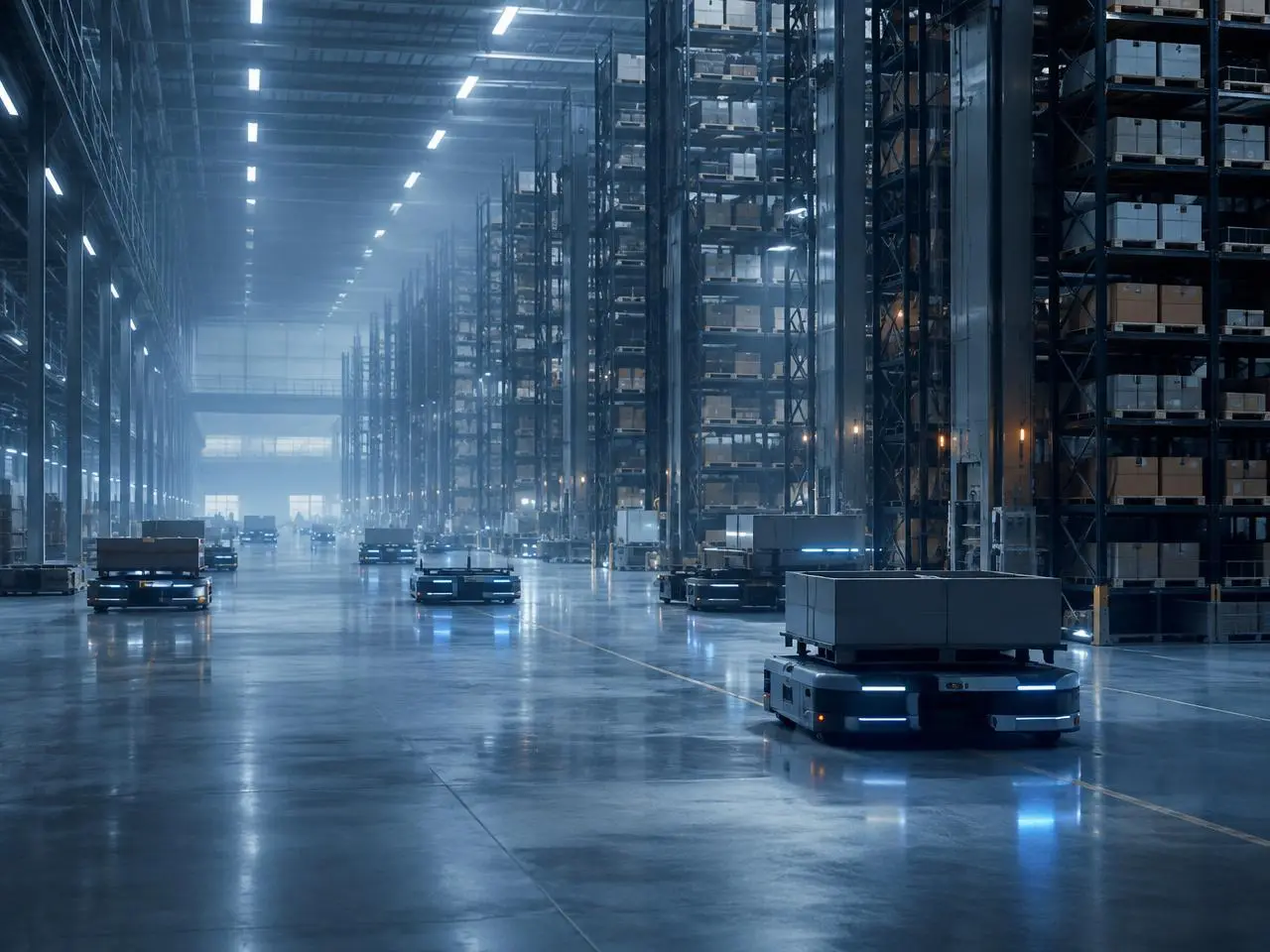
Two kinds of mobile equipment come up constantly. An autonomous mobile robot (AMR) moves through a facility using its own sensors and onboard navigation, choosing its path around obstacles. An automated guided vehicle (AGV) follows fixed routes, such as floor markers, magnetic tape or set guide paths. A WES can assign work to both, typically through the fleet software that controls them.
The terms that sit beside WES are easy to blur:
- Warehouse management system (WMS): keeps inventory records, manages orders and makes slotting decisions, meaning where each item is stored. A WMS answers what is in the building and what needs to ship.
- Warehouse control system (WCS): sends low-level signals to individual machines, such as starting a conveyor section or telling a sorter which lane to divert an item into.
- WES: sits above the WCS and makes cross-system decisions about task sequencing and resource allocation, such as which order to release next and whether a person, a robot or a goods-to-person station picks it.
Some vendors combine WES and WCS functions in a single platform. In that case, one product both decides the work sequence and sends the commands that move equipment, so the boundary between the two exists inside the software rather than between two systems.
A WES becomes relevant wherever a facility mixes automated equipment with human labor and needs real-time coordination across both. A building with manual picking and no material-handling automation has less for an execution layer to coordinate.
How WES Fits Into a Facility's Automation Stack
The warehouse software stack works as a set of layers, each with its own job. At the top sits enterprise resource planning (ERP), the business system that handles orders, purchasing, finance and inventory value across the company. Beside or below it sits the WMS. In a plant, a manufacturing execution system (MES), the software that tracks and directs production work on the shop floor, may also feed demand to storage and kitting areas.
Data moves through the stack in a loop:
- The ERP or WMS passes order and inventory data down to the WES.
- The WES translates that data into real-time task assignments for equipment and workers.
- Equipment and workers carry out the tasks, and the WES passes status and completion data back up.
Below the WES sits the machine-control layer: the WCS and programmable logic controllers (PLCs), the industrial computers that run individual machines. This position between business logic and machine control is sometimes called the middle tier of the warehouse software stack.
Not every facility has a WCS. Without one, a WES may communicate directly with equipment controllers, including PLCs, sorter controllers and AMR fleet managers. That design removes a layer, but it places more machine-level integration work inside the WES project.
The connectivity that feeds equipment status to a WES is the Industrial Internet of Things (IIoT): networked sensors, controllers and devices that report machine states, faults and positions so software can act on them.
For a controls or operations engineer, the integration points matter more than any single feature. The number of systems, the communication protocols in use and the variety of equipment types are primary drivers of implementation scope. A stack with one WMS and one conveyor line is a different project from one with an ERP, an MES, two robot fleets and a sorter from another manufacturer.
Operational Requirements and Constraints to Assess Before Selecting a System
Facility conditions decide which WES capabilities matter. These points shape scope:
- Throughput and order profile. Peak order volume, order mix (single-line versus multi-line orders) and SKU count all affect the task-sequencing logic a WES must handle.
- Equipment inventory. The conveyors, sorters, AMRs, AGVs, put walls and goods-to-person systems already in place each need a working integration, whether a tested connector or an open application programming interface (API), a published way for software to exchange data.
- Labor mix. The ratio of automated to manual tasks affects how a WES allocates work and how it presents instructions to workers, whether through RF scanners, pick-to-light displays or voice-directed picking.
- Existing software stack. The versions of the WMS, ERP and MES in use, and their API or integration capabilities, determine how a WES connects to the business layer.
- Network and OT infrastructure. A WES relies on dependable, low-latency connectivity across the floor, so the existing industrial network is part of the scope.
Implementation scope and timing
The same factors that shape scope also shape how long an implementation runs. Each additional system, protocol and equipment type adds integration and testing work, and a facility without a WCS moves more machine-level integration into the WES project itself. A provider's written proposal is where the schedule for a given configuration is stated.
Cybersecurity
Cybersecurity enters once a WES links business systems to operational technology (OT), the hardware and software that monitor and control physical equipment. Protecting that connection is a matter for the facility's own security program. NIST describes its Cybersecurity Framework 2.0 (CSF 2.0) as a resource for industry, government and organizations to reduce cybersecurity risks, and offers quick start guides, CSF 2.0 profiles and informative references alongside it. In plain terms, the framework is voluntary guidance; connecting a WES does not by itself make a facility secure or conformant with it.
Workplace safety
Automation changes how work moves around people, but safety duties stay with the employer. Under 29 U.S.C. § 654, each employer shall furnish each employee employment and a place of employment free from recognized hazards that are causing or are likely to cause death or serious physical harm, and shall comply with occupational safety and health standards promulgated under that chapter. Employees, for their part, shall comply with the standards, rules, regulations and orders applicable to their own actions and conduct.
OSHA's Warehousing page lists potential hazards in warehousing that include powered industrial trucks (forklifts), ergonomics, material handling, hazardous chemicals, slips, trips and falls, and robotics. The same page states that OSHA's National Emphasis Program on Warehousing and Distribution Center Operations applies OSHA-wide, with inspections under the updated program beginning July 31, 2026.
Forklifts often share aisles with WES-directed work. 29 C.F.R. § 1910.178 contains safety requirements relating to fire protection, design, maintenance and use of fork trucks, tractors, platform lift trucks, motorized hand trucks and other specialized industrial trucks powered by electric motors or internal combustion engines. AMR traffic and conveyor interactions change some hazard profiles, so the facility's safety program accounts for how WES-directed equipment operates around people. OSHA and the equipment maker are the sources for how a requirement applies to a given installation, and some states run their own occupational safety plans with rules that can differ from the federal text.
Facility size, automation level and order profile shape these requirements, and a provider's written proposal states what a given configuration covers.
Comparing WES Deployment and Integration Approaches
Each deployment model trades one burden for another. The comparison uses five criteria: equipment integration depth, WMS and ERP connectivity, deployment model, ability to scale to additional sites, and vendor support model. It describes how these approaches are generally structured, not any product.
| Approach | Equipment integration depth | WMS and ERP connectivity | Main trade-off |
|---|---|---|---|
| Standalone WES | Typically the deepest equipment integration, as a purpose-built execution layer | Requires its own integration work with the WMS and ERP | More integration effort at the business layer |
| WMS-embedded WES | May have shallower equipment-level integrations | Reduced integration overhead, since the execution module sits within the WMS platform | Equipment coverage depends on the module |
| MES with warehouse execution | Oriented to manufacturing-adjacent storage and kitting | Shares the production system's data | Scope tied to the plant floor rather than full fulfillment |
Deployment location is a separate choice from product type:
- Cloud-hosted: reduces the on-site infrastructure burden, but real-time execution then depends on connectivity to the hosted system and on the latency of that connection.
- On-premises: keeps execution local to the facility, but requires the facility's own IT and OT infrastructure to host and maintain it.
Scaling to additional sites and the vendor support model are worth comparing within each approach, since neither follows automatically from the model chosen. Both choices connect directly to the equipment and network conditions in the building, which is why facility requirements are usually settled before an approach is compared.
What to Evaluate When Assessing WES Options
A request for quotation (RFQ) or request for proposal (RFP) is the formal document a buyer issues to vendors to obtain comparable, structured responses. Each evaluation point that follows translates into RFQ or RFP questions.
Equipment compatibility
The useful question is whether a vendor has production-proven integrations with each piece of automated equipment in the facility, not only whether an API exists. A connector running in live sites with the same equipment carries different weight from one that exists on paper.
WMS and ERP integration
Reference sites running the same WMS and ERP versions, and the same integration pattern, show how a vendor handles a comparable business layer.
Ability to scale
The point to assess is whether the system handles the facility's peak throughput and can extend to additional sites or equipment types without a full re-implementation.
Total cost of ownership
Total cost of ownership (TCO) is the full cost of a system over its life. It breaks into components and drivers:
- Components: license or subscription, implementation, integration, training, ongoing support and upgrades.
- Drivers: facility size, automation level, number of integrations, deployment model (cloud or on-premises) and the services bundled with the system.
Comparing proposals component by component makes the drivers visible. A provider's written proposal states the figures for a specific configuration.
Commissioning and go-live support
Commissioning is the process of testing and bringing a system into live operation. The questions here cover what the vendor's commissioning process includes, how cutover from existing systems is managed, and what support is available during early live operation.
Vendor stability and support model
A vendor's track record with facilities of similar size and automation complexity, and how its support is structured after go-live, round out the evaluation.
Before an RFQ goes out, the practical preparation is a current equipment list, an inventory of the software stack with versions, and the facility's peak throughput figures, which together give vendors what they need to scope the integration.
Independent referral
Your next project deserves a clearer starting point.
Describe your requirements. Where there is a fit, we may introduce you to relevant providers.
Industrial Technology Exchange
How the independent referral process works
- DescribeSubmit a short inquiry describing your project, facility and timeline.
- ReviewWe review the inquiry for clarity and fit. Incomplete or out-of-scope requests may not be referred.
- ConnectWith your consent, relevant third-party providers may contact you. You decide whether to engage.
Testimonials
Frequently asked questions
What is the difference between a WES and a WMS?
Consider a multi-line order. The WMS knows the items are in stock, where each is stored and that the order needs to ship. The WES decides when to release that order to the floor and whether a person, a robot or a goods-to-person station picks each line. The two exchange data but work at different layers.
What does a warehouse execution system do that a WMS does not?
When conditions shift mid-shift, such as a conveyor fault or a surge of orders, a WES rebalances the work: resequencing picks, rerouting AMRs and AGVs and adjusting conveyor flow. A WMS typically does not manage equipment at that level of real-time detail.
What is the difference between a WES and a WCS?
In a facility with a sorter, the WES decides which orders go to the sorter and in what sequence; the WCS tells the sorter which lane each item diverts into. Where one platform combines both functions, that split happens inside a single product.
What are the main types of warehouse management systems?
The main categories are standalone WMS platforms, WMS modules embedded in an ERP, and WMS platforms that include WES functionality. WES itself is a distinct layer focused on real-time execution rather than inventory record-keeping.
How much does a WMS cost?
A provider's written proposal states the figures for a specific configuration. The cost drivers include facility size, automation level, number of integrations, deployment model (cloud or on-premises) and the services bundled, such as implementation, training and support.
What cybersecurity considerations apply to warehouse execution software?
A WES connects to OT equipment and to business systems, which places it inside the facility's OT security perimeter. NIST's Cybersecurity Framework 2.0 is voluntary guidance that organizations use to reduce cybersecurity risks, and the facility's own security program addresses how the connections are protected.