
You may be a plant engineer, an operations manager or a procurement lead weighing whether a welding line should move to automation. The useful questions come in a natural order: what the cell is made of, whether your parts and volumes suit it, which federal safety rules apply, how the configurations differ, what drives cost and risk, and what a supplier needs to see in an RFQ.
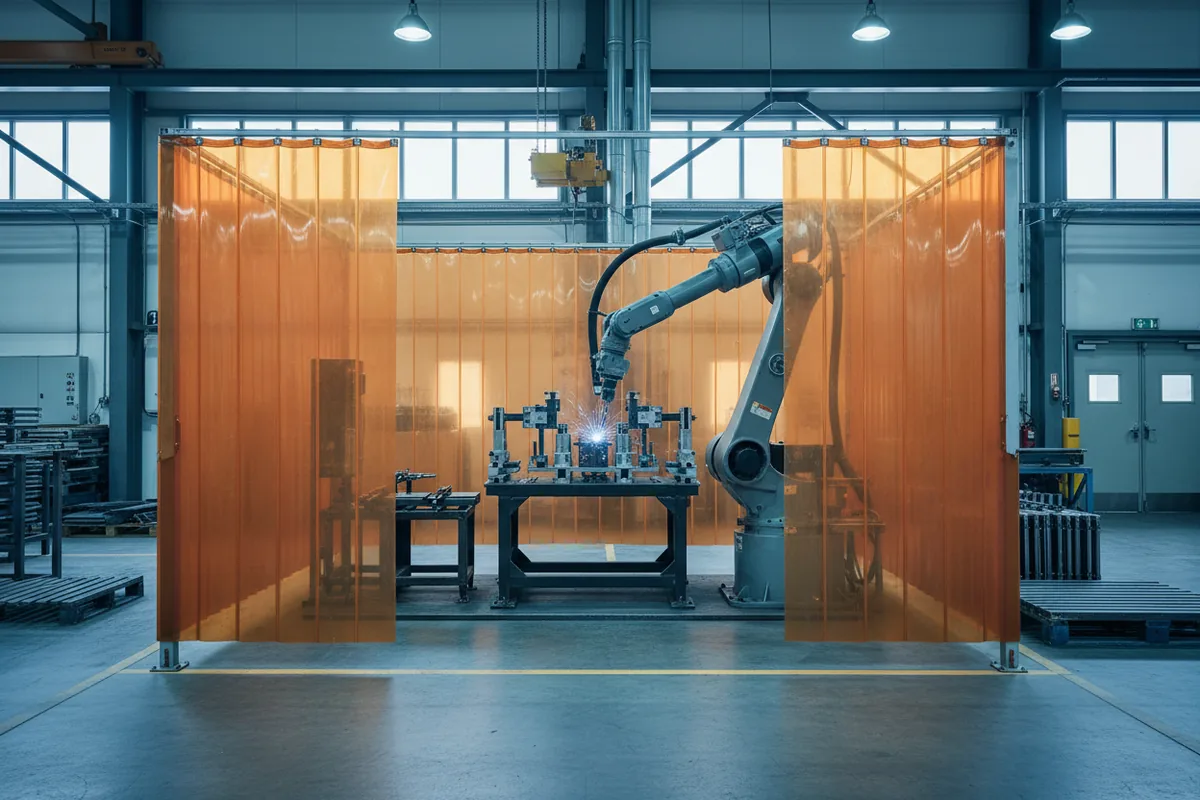
A robotic welding system is a complete welding cell, not just a robot. A programmable arm moves a torch or gun along a taught path. A power source, wire feeder, controller and fixture work with it, and guarding surrounds it. The system repeats the same weld on parts that arrive in the same position each cycle.
On this page
- What a Robotic Welding System Is and What It Does
- Where Robotic Welding Fits in a Manufacturing Operation
- Safety, Guarding, and Regulatory Requirements for Robotic Welding Cells
- System Options: Integrated Cells, Cobot Welding, and Custom Configurations
- What Drives Cost and Project Risk in a Robotic Welding Installation
- Evaluating Suppliers and Preparing an RFQ for a Robotic Welding System
- Frequently asked questions
- Sources
What a Robotic Welding System Is and What It Does
OSHA's Robotics page describes industrial robots as "programmable multifunctional mechanical devices designed to move material, parts, tools, or specialized devices through variable programmed motions." It lists welding among their functions, alongside material handling, assembly and painting.
A welding robot only produces welds as part of an integrated cell. The core components are:
- Articulated robot arm: the jointed manipulator that carries the torch or gun through the programmed path.
- Welding power source: the unit that supplies and controls the welding current for the chosen process.
- Wire feeder: the drive that pushes filler wire to the torch in wire-fed arc processes.
- Torch or gun: the tool at the end of the arm that delivers the arc, the current or the beam to the joint.
- Robot controller: the computer that stores programs and coordinates the arm, the power source and the cell's other devices.
- Fixture or positioner: the fixture holds the part in a repeatable position, and a positioner rotates or tilts it during welding.
- Safety enclosure or light curtain: the guarding that separates people from the robot's working area.
A cell is configured for one welding process or a limited range of them:
- Gas metal arc welding (GMAW, or MIG): an arc between a continuously fed wire and the work, shielded by gas.
- Gas tungsten arc welding (GTAW, or TIG): an arc from a non-consumable tungsten electrode, with filler added separately where needed.
- Plasma arc welding: a constricted, focused arc formed through a nozzle.
- Resistance or spot welding: current passed through clamped sheets to fuse them at points.
- Laser welding: a focused laser beam that melts and joins the material.
The American Welding Society (AWS) is the professional body that publishes welding standards and terminology. A supplier can state which AWS documents its process work follows.
Two system types are worth separating. A traditional industrial welding robot works inside a full enclosure, and no person is in the cell while it runs. A collaborative robot, or cobot, is designed to work closer to people. It relies on limits on its force and speed rather than on a full enclosure.
Where Robotic Welding Fits in a Manufacturing Operation
Repetition is the main fit condition. A robot follows its programmed path exactly, which suits high-volume production of the same part with the same weld, made the same way each time.
Part consistency is the other prerequisite. The robot does not see where the part is unless the cell adds sensing for that purpose. If a part arrives shifted, or its dimensions drift from one batch to the next, the torch still follows the original path. Consistent fixturing, and parts that fit up the same way, are what make a robotic weld repeatable.
Applications that match these conditions include:
- Automotive body and chassis assemblies
- Heavy equipment frames
- Structural steel members
- HVAC components
- Pressure vessels
These are examples, not a complete list.
The fit weakens in some situations:
- Low-volume custom work, where programming and fixturing are repeated for each new part.
- Highly variable part geometry, where no single fixture or path holds.
- Thin or delicate materials, where a welder adjusts technique continuously by judgment.
Cobot welding is one route for lower-volume or mixed production, where a full enclosure cell is impractical. Which side of that line a given part mix falls on is a question the plant's own drawings and production records answer.
Safety, Guarding, and Regulatory Requirements for Robotic Welding Cells
The starting point is the employer's general duty. Under federal law, each employer must keep the workplace free from recognized hazards that are causing or likely to cause death or serious physical harm, and must comply with occupational safety and health standards issued under the Occupational Safety and Health Act (29 U.S.C. § 654). For a buyer, this means safety responsibility stays with the plant operating the cell, whatever equipment is purchased.
No robotics-specific OSHA standard. OSHA's Robotics page states: "There are currently no specific OSHA standards for the robotics industry." The same page notes that studies indicate many robot accidents occur during non-routine conditions, naming programming, maintenance, testing, setup and adjustment, when a worker may be within the robot's working envelope. For a welding cell, that points attention to the moments when people step inside, not only to normal running. When reviewing a proposed cell, a buyer can look at how a technician enters it to teach a path or change a tip, not only at how it is fenced during production.
Machine guarding. The general machine guarding rule, 29 C.F.R. § 1910.212, fills much of the gap. It states that "one or more methods of machine guarding shall be provided to protect the operator and other employees in the machine area" from hazards such as those created by point of operation, ingoing nip points, rotating parts, flying chips and sparks. Barrier guards, two-hand tripping devices and electronic safety devices are among the examples it gives.
Hazardous energy control. 29 C.F.R. § 1910.147 covers lockout/tagout, and it reaches much of the work done on a cell outside production. It defines servicing and maintenance to include setting up, adjusting, inspecting and modifying machines, and making adjustments or tool changes. It also requires an on-site employer and an outside employer, such as an integrator's crew, to inform each other of their respective lockout or tagout procedures. The equipment maker and the plant's own energy control program state the actual procedures for a given cell.
Welding standards and fumes. OSHA's Welding, Cutting, and Brazing page states that welding, cutting and brazing are "addressed in specific OSHA standards for general industry, maritime, and construction." The page lists an OSHA fact sheet, Controlling Hazardous Fume and Gases during Welding (Publication 3647, 2013). Fume control and ventilation are a separate concern from guarding the robot.
Industry standard. ANSI/RIA R15.06 is the industry safety standard that suppliers and integrators reference for industrial robots. Its requirements come from the standard itself, which a supplier can identify in its proposal.
No robotic welding system makes a facility compliant by itself. Compliance turns on how the cell is installed, guarded and operated. OSHA, and the qualified engineer or equipment maker responsible for the installation, decide how these rules apply to a particular cell.
System Options: Integrated Cells, Cobot Welding, and Custom Configurations
Three procurement routes cover the main choices. They differ in flexibility, footprint, fixturing, programming and integration.
| Criterion | Turnkey integrated cell | Cobot welding setup | Custom-engineered system |
|---|---|---|---|
| What it is | Pre-engineered enclosure, robot, power source and controller from one supplier or systems integrator | Collaborative robot carrying a welding torch | System designed around specific parts, which may include multiple robots, positioners and conveyors |
| Guarding approach | Full enclosure | Typically no full enclosure | Engineered to the layout of the cell |
| Footprint | Set by the pre-engineered enclosure | Lower footprint | Set by the custom layout |
| Flexibility | Less flexible for unusual part geometries | Suited to lower-volume or mixed production | Highest flexibility |
| Engineering burden | Less engineering for the buyer; faster deployment | Depends on fixtures and part mix | Highest engineering and integration cost and risk |
The comparison uses the criteria a buyer applies to a welding project. It describes each route as it generally works, not as any supplier sells it.
Fixturing and positioners are a major variable in any of the three. A fixture locates and clamps the part. A positioner turns or tilts it so the torch reaches each joint at a workable angle.
Programming approach differs as well:
- Teach pendant programming: a technician jogs the robot through the path with a handheld control and records each point on the floor.
- Offline programming: software generates the path from a computer-aided design (CAD) model of the part, away from the cell.
Integration with plant systems is a compatibility question for any route. A programmable logic controller (PLC) is the industrial computer that runs machine logic. Supervisory control and data acquisition (SCADA) software monitors and controls equipment across a site. A manufacturing execution system (MES) tracks production orders and records. Each supplier can say how its controller exchanges data with the systems already on the plant floor.
What Drives Cost and Project Risk in a Robotic Welding Installation
Total cost of ownership (TCO) is the full cost of the system over its operating life. It includes acquisition, installation, integration, training, consumables and maintenance. The purchase price of the robot is only one line in that total, and the supplier's written proposal states the figures.
The factors behind those figures are:
- Robot payload and reach: part weight, torch weight and the distance to the farthest joint set the size of arm required.
- Welding power source: a separate specification, matched to the process and the material.
- Fixturing and tooling: designed around the specific parts, and a cost driver of their own.
- Systems integration: connecting the robot controller to a PLC, SCADA or MES adds engineering hours and project risk.
- Facility requirements: floor space, electrical service, ventilation and fume extraction, and compressed air may each need modification.
- Programming and commissioning: offline programming moves path work away from the cell. Commissioning is the process of confirming the system performs to specification in the actual production environment.
- Training: operator and maintenance training recurs as staff change and programs are added.
- Consumables and spare parts: contact tips, liners, nozzles and wire are ongoing operating costs.
Project risk follows the same factors. Inconsistent parts, an unclear integration scope or late facility changes tend to surface during commissioning, when the cell meets real production.
Evaluating Suppliers and Preparing an RFQ for a Robotic Welding System
A request for quotation (RFQ) is the formal document a buyer sends to potential suppliers to request a priced proposal. A clear RFQ also makes proposals from different suppliers comparable on the same terms. Most of what it contains is information the plant already holds; the work lies in gathering it in one place before suppliers are asked to price anything.
Step 1: Specify the work
The first part of an RFQ describes the parts and the setting the cell will work in:
- Part drawings and weld specifications: joint types, materials, thicknesses and the quality criteria each weld must meet.
- Production volume and cycle requirements: the volumes and the cycle the line has to sustain, drawn from the plant's own records.
- Existing equipment and controls: the PLC, SCADA, MES and upstream or downstream equipment the cell must connect with.
- Facility constraints: available floor space, electrical service and ventilation.
- Acceptance test criteria: the measurable conditions the cell must meet before the buyer accepts it.
Step 2: Define the acceptance checkpoints
Acceptance usually happens twice. A factory acceptance test (FAT) is run at the supplier's facility before shipment. It shows that the cell performs to the agreed criteria. A site acceptance test (SAT) is run after installation at the buyer's plant, under actual production conditions. The RFQ can state which criteria apply at each test, so both sides know in advance what counts as a finished cell.
Step 3: Ask each supplier the same questions
Asking every supplier the same set of questions makes the answers comparable side by side:
- Who performs commissioning, and how is acceptance defined?
- What operator and maintenance training is included?
- What does the warranty cover, and for which components?
- Which spare parts are stocked locally?
- Is offline programming software included or sold as a separate purchase?
- Which safety standards, including ANSI/RIA R15.06, does the cell design reference?
- What welding credentials do the integrator's personnel hold? AWS issues credentials for welding personnel, including one for robotic arc welding, and a buyer may specify them in the RFQ.
The practical next step on a robotic welding project is assembling current part drawings, weld specifications and production volume data. Those documents are what a supplier needs to respond to an RFQ with a specific proposal.
Independent referral
Your next project deserves a clearer starting point.
Describe your requirements. Where there is a fit, we may introduce you to relevant providers.
Industrial Technology Exchange
How the independent referral process works
- DescribeSubmit a short inquiry describing your project, facility and timeline.
- ReviewWe review the inquiry for clarity and fit. Incomplete or out-of-scope requests may not be referred.
- ConnectWith your consent, relevant third-party providers may contact you. You decide whether to engage.
Testimonials
Frequently asked questions
What is a robotic welding system?
A robotic welding system is an integrated cell in which a programmable robot arm performs welds with consistent repeatability. Besides the robot, the cell includes a welding power source, a controller, fixturing to hold the part, and guarding such as an enclosure. Taken together, these make up the system.
What welding processes can a robotic welding system perform?
The processes include GMAW (MIG), GTAW (TIG), plasma arc welding, resistance or spot welding, and laser welding. A cell is configured for one process or a limited range of processes. The choice follows the material, the joint design and the production requirements.
What is a welding fixture?
A welding fixture is a device that holds a workpiece in a precise, repeatable position during welding. A robot follows a programmed path. When a part is not in the same position every cycle, the weld lands off the joint and quality suffers.
What are the main components of a robotic welding system?
The components are the articulated arm, the welding power source, the wire feeder for wire-fed arc processes, the torch or gun, and the robot controller. A fixture or positioner holds and orients the part. A safety enclosure or light curtain provides the guarding.
What OSHA standards apply to robotic welding?
OSHA's Robotics page states there are no specific OSHA standards for the robotics industry. Under 29 C.F.R. § 1910.212, one or more methods of machine guarding must protect operators and others from hazards such as point of operation and nip points. OSHA's Welding, Cutting, and Brazing page states that welding is addressed in specific standards for general industry, maritime and construction.
What is the difference between a robotic welding cell and a cobot welding setup?
The difference shows up in how each is used on the floor. A traditional cell keeps people out while it runs, which suits high-volume, repeated parts. A cobot setup takes a lower footprint and suits lower-volume or mixed production, though its cost and results still depend on the fixtures and the part mix.
What drives the cost of a robotic welding system?
Cost follows the arm's payload and reach, the power source, and the fixturing and tooling. Integration with plant controls, facility changes, programming and commissioning add to it. Training, consumables and maintenance continue for the life of the system. A supplier's written proposal states the figures.
What is offline programming for a robotic welder?
Offline programming generates the robot's weld path from a CAD model of the part, without teaching it manually on the production floor. It also allows the path to be simulated before commissioning. Teach-pendant programming, by contrast, records the path point by point at the robot itself.