

A plant engineer facing load growth, an operations manager dealing with outages that stop a line, or a procurement lead asked to scope an onsite power project faces a similar decision: which part of the plant's energy system to change, which technology fits the load, and how to judge the contractors and integrators who would build it. What follows lays out the technology categories, the cost drivers and the supplier questions for a U.S. industrial facility, as groundwork for a scope or an RFQ (request for quotation) with fewer unknowns.
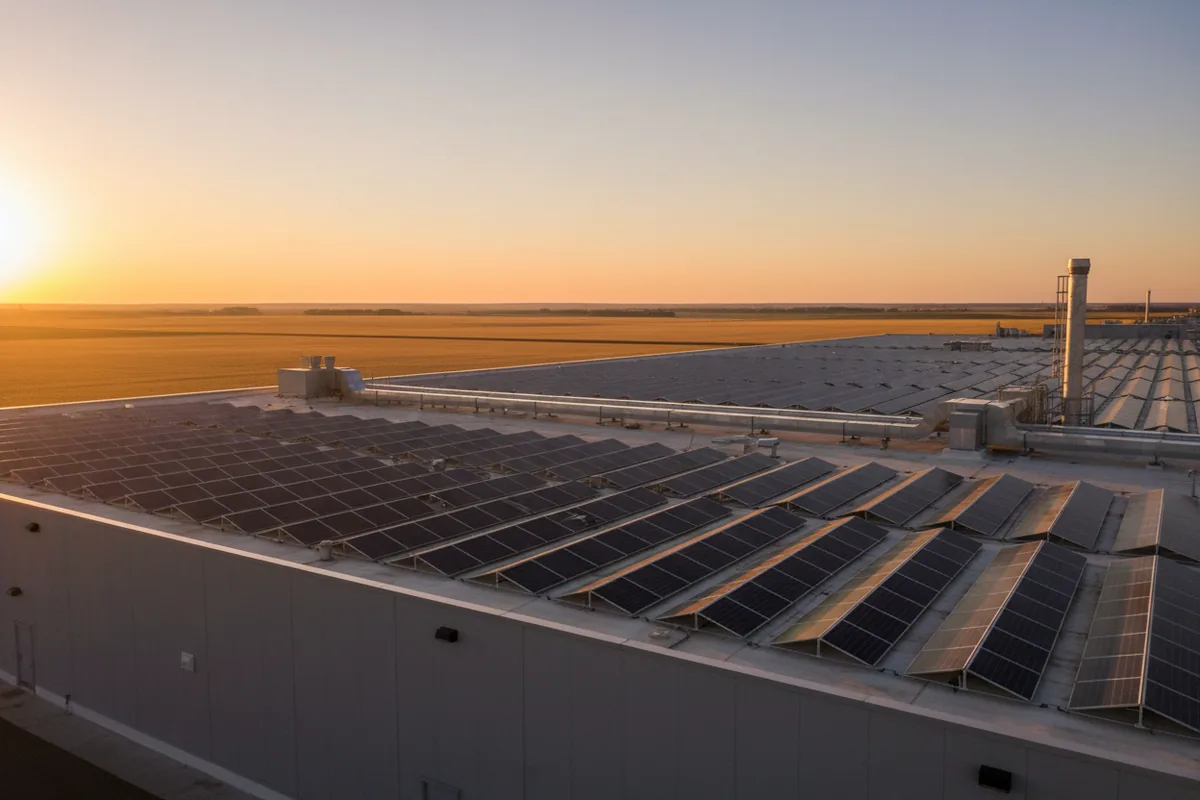
Industrial energy and infrastructure is the set of physical systems and controls that bring power and utilities into a plant, generate or store them on site, distribute them to the process, and keep them running. It includes the utility feed, onsite generation such as combined heat and power or solar with batteries, compressed air, steam, process cooling, and the control systems that monitor all of it.
On this page
- Key Takeaways for Industrial Energy and Infrastructure
- Facilities and Operations Where Energy Infrastructure Projects Fit
- How Industrial Energy Infrastructure Works at a Plant
- Options and How They Differ for Industrial Energy Infrastructure
- How to Evaluate a Provider for an Energy Infrastructure Project
- What Drives the Cost of an Industrial Energy Infrastructure Project
- When an Industrial Energy Infrastructure Project Is Not the Right Fit
- Questions to Ask Before Scoping an Industrial Energy Infrastructure Project
- Frequently asked questions
- Sources
Key Takeaways for Industrial Energy and Infrastructure
The core points fit in a short list:
- Scope: Industrial energy infrastructure covers the systems that generate, distribute, manage and condition power and utilities at a facility.
- Categories: Onsite generation (combined heat and power, microgrids, solar, battery storage), utility interconnection, compressed air, steam, process cooling and the controls layer form the main groups.
- Controls: Industrial control systems (ICS) and operational technology (OT) are the layer that connects plant equipment to operators, and connecting it to business networks raises cybersecurity questions.
- Combinations: The options can be combined; a plant may pair one generation technology with a utility upgrade or a load program.
- Neighboring work: Energy management software and energy audits sit close to infrastructure projects and often inform them, but they are a different kind of purchase from capital equipment.
- Price: The scope, load, site and integration work set the cost, and a provider's written proposal states it.
Facilities and Operations Where Energy Infrastructure Projects Fit
Load shape decides relevance more than plant size does. Facilities with high, continuous process loads, such as food and beverage, chemicals, metals, paper, plastics and automotive plants, feel a power interruption directly as lost production, so the reliability of supply is a production question there.
Plants that produce significant waste heat, or that use steam and hot water around the clock, are the ones where combined heat and power can be studied seriously, because the thermal output has somewhere to go. Facilities served by utilities with high tariffs, demand charges (fees based on the highest rate of power draw in a billing period) or a history of reliability problems also have reasons to look at onsite generation, storage or load programs.
Small and medium-size manufacturers have a federal starting point. The U.S. Department of Energy's Industrial Training and Assessment Centers page describes Industrial Training and Assessment Centers (ITACs), formerly Industrial Assessment Centers, that provide hands-on technical assistance to small and medium-size manufacturers. DOE states that the centers are located at four-year colleges, community colleges, trade schools and union training programs. How the assessments work is described with the provider criteria further on.
The fit is weaker at the other end. A facility with very low or intermittent loads, or one where the grid is the only practical source of power, may find an onsite generation project hard to justify, because the equipment would sit idle much of the time.
How Industrial Energy Infrastructure Works at a Plant
A plant's energy system works as three layers that pass power and information between them. The layers describe function only; design, installation and wiring belong to the qualified engineers and the equipment makers on a given project.
Step 1: Power and fuel enter through the generation layer
The generation layer is where energy originates: the utility feed, any onsite generation such as a CHP unit or solar array, and any storage such as batteries. Fuel supply for onsite generators belongs to this layer as well.
Step 2: The distribution layer carries energy to the process
Switchgear, transformers and electrical bus move electric power to loads. Compressed air headers and steam headers do the same job for those utilities, delivering them to the machines and process steps that consume them.
Step 3: The controls layer monitors and directs the equipment
The controls layer includes ICS and OT, SCADA (supervisory control and data acquisition, software that gathers data from field equipment and lets operators supervise it), PLCs (programmable logic controllers, industrial computers that run equipment logic), DCS (distributed control systems used in continuous processes) and energy management systems. CISA's Industrial Control Systems page defines ICS and OT as "the systems and devices that interact with the physical environment" and states that they are the foundation of U.S. critical infrastructure, naming the Energy and Critical Manufacturing sectors among others.
This layer connects physical equipment to operator screens and, increasingly, to plant business networks. That connection is what creates cybersecurity considerations: the same CISA page states that CISA provides guidance based on emerging threats, as well as services and tools to help secure ICS/OT, and it lists a 2026 cybersecurity advisory on threat actors targeting a family of PLCs.
Options and How They Differ for Industrial Energy Infrastructure
Five options account for most onsite energy infrastructure work, and they solve different problems.
Combined heat and power (CHP) generates electricity and useful thermal energy at the same time from a single fuel source. It applies to facilities whose electric and thermal loads occur together.
A microgrid is a localized group of electricity sources and loads that can operate connected to the main grid or islanded from it, meaning running on its own during a grid outage. It is relevant where resilience or islanding is a requirement.
Solar photovoltaic with battery storage pairs generation with storage. Roof or ground area, the local solar resource and the utility's interconnection rules shape whether it is feasible.
Demand response is a program in which a facility reduces or shifts load in response to grid signals or pricing. Unlike the other four options, it adds no generating equipment; it changes when and how much of the plant's existing load runs. The work centers on identifying which loads can be reduced or moved without harming production, and on the controls and operating procedures that carry out the change when a signal arrives. Participation rules, including how signals are sent and how participation is credited, differ by utility and region.
A utility service upgrade expands or improves the feed from the utility. It becomes relevant when load growth exceeds the capacity of the existing service.
| Option | What it changes | Load or need it relates to | Main feasibility factors |
|---|---|---|---|
| CHP | Adds onsite electric and thermal generation | Coincident electric and thermal loads | Load profile, fuel availability |
| Microgrid | Adds sources and loads that can island | Resilience and islanding needs | Resilience requirements, interconnection rules |
| Solar PV with storage | Adds generation plus storage | Daytime electric load, storage needs | Roof or ground area, solar resource, interconnection rules |
| Demand response | Changes when and how much load runs | Loads that can be reduced or shifted | Utility and regional program rules |
| Utility service upgrade | Expands the incoming feed | Load growth beyond current service | Utility capacity at the site |
These options are not mutually exclusive. A plant might add CHP for its steam load, arrange islanding through a microgrid controller and enroll part of its load in a demand response program.
How to Evaluate a Provider for an Energy Infrastructure Project
Scope fit is the first test. A capable provider describes the project in terms of the facility's load profile, existing infrastructure and integration requirements, not only in terms of the equipment it would install. The criteria below give a consistent way to compare contractors, integrators and technology providers.
- Scope definition: Ask the provider to restate the scope in its own words, tied to the facility's load data and single-line diagram.
- ICS and OT integration: Ask how it integrates with existing SCADA, PLC or DCS systems and which OT cybersecurity practices it follows. CISA publishes role-specific guidance for asset owners and operators, for integrators and engineering firms, and for OT vendors, and lists a September 23, 2026 fact sheet on how critical infrastructure operators can work with third-party ICS integrators on secure practices.
- Commissioning and handoff: Ask what commissioning documentation, operator training and as-built drawings are delivered. Commissioning is the testing and startup that confirms a system works as designed.
- References: Ask for references from facilities with similar load profiles, process types and utility tariff structures.
- Contract terms: Ask what the contract covers for performance testing, warranty and support after commissioning.
For small and medium-size manufacturers, an ITAC assessment can inform the scope before any provider is engaged. DOE's Industrial Training and Assessment Centers page describes the assessments as in-depth facility evaluations conducted by engineering faculty with upper-class and graduate students from a participating university. DOE states that after a remote survey of the plant, the team conducts a one or two-day site visit to take engineering measurements and performs a detailed process analysis to generate specific recommendations, and that within 60 days the plant receives a report detailing the analysis, findings and recommendations.
What Drives the Cost of an Industrial Energy Infrastructure Project
Scale and load come first. The size of the facility's electrical and thermal load sets the size of any generation equipment, and that size drives the largest share of a generation project's cost.
The technology selected shapes the cost profile. CHP, microgrids, solar-plus-storage and demand response each carry a different mix of capital, installation and integration costs, and a demand response program involves controls and operating changes rather than generating equipment.
Site conditions change installed cost. Existing electrical infrastructure, available space, fuel supply and the utility's interconnection requirements each affect what has to be built or modified before new equipment can run.
Integration complexity adds engineering and commissioning work. A project that ties into existing ICS, SCADA or plant networks carries design, testing and OT security effort beyond the equipment itself.
Utility tariff structure affects the economics. Demand charges, interconnection fees and net metering or export rules (the terms for sending power back to the grid) differ by utility and by state.
Incentive programs can also change the economics. DOE's Industrial Training and Assessment Centers page, last updated October 2, 2026, states that grants of up to $300k per qualified recommendation are available to implement energy efficiency projects, and that implementation grants are designed to help small- and medium-sized manufacturers implement recommendations made in ITAC or equivalent assessments. Whether any federal or state program applies to a given project is stated by the program's own terms, and the provider's written proposal states the project's price.
When an Industrial Energy Infrastructure Project Is Not the Right Fit
Utilization is the usual breaking point. A facility with low, intermittent or highly variable loads may not run onsite generation enough of the time for the equipment to earn its place in the plant.
Interconnection can stop a project. Where utility interconnection is not feasible at the site, or where the utility's tariff structure does not support the economics of the technology under consideration, the project may not move forward in its proposed form.
The existing electrical system can change the project. When switchgear, transformers or service capacity cannot support the new equipment without a major upgrade, the scope becomes a different and larger project, and the original plan may no longer hold.
Sometimes the need is operational rather than capital. A plant whose main questions are about where energy goes and when may find that monitoring, energy management work or an energy audit answers them before any infrastructure purchase. For any facility, the load data and the utility's terms settle most of these questions early.
Questions to Ask Before Scoping an Industrial Energy Infrastructure Project
These questions serve the plant's own team first and then each provider before an RFQ goes out.
- Load: What are the facility's current peak demand, average load and load profile by hour and season?
- Thermal load: Does the facility have a significant, consistent thermal load, such as steam, hot water or process heat, that CHP could serve?
- Utility terms: What are the utility's interconnection requirements and tariff structure for onsite generation?
- Flexible load: Which loads could be reduced or shifted under a demand response program without disrupting production?
- Controls: What ICS, SCADA or DCS systems are in place, and what integration would the project require?
- Resilience: Does the facility need islanding capability, and for which loads?
- Prior assessment: Has the facility had an ITAC assessment or a comparable energy assessment? DOE states that manufacturers can contact the closest ITAC location about receiving one.
Two documents commonly anchor the next step: interval load data, meaning 15-minute or hourly demand records available from the utility, and a current single-line electrical diagram of the facility. A scoping conversation with a provider typically starts from these two records.
Independent referral
Your next project deserves a clearer starting point.
Describe your requirements. Where there is a fit, we may introduce you to relevant providers.
Industrial Technology Exchange
How the independent referral process works
- DescribeSubmit a short inquiry describing your project, facility and timeline.
- ReviewWe review the inquiry for clarity and fit. Incomplete or out-of-scope requests may not be referred.
- ConnectWith your consent, relevant third-party providers may contact you. You decide whether to engage.
Testimonials
Frequently asked questions
What does energy infrastructure include?
Industrial energy infrastructure includes the physical systems that generate, distribute and condition power and utilities at a facility. That covers onsite generation such as CHP, solar, battery storage and microgrids, the utility interconnection, compressed air, steam, process cooling, and the ICS and OT controls layer that monitors and directs the equipment.
What is industrial infrastructure?
Industrial infrastructure is the physical and control systems a manufacturing or processing facility depends on to operate: power, utilities, compressed air, process fluids and the systems that control them. In CISA's framing, the control systems are the part that interacts directly with physical equipment.
Who are energy infrastructure partners for a manufacturing plant?
The providers involved are engineering firms, equipment manufacturers, systems integrators and utility programs. Which of them a project involves follows from the scope, the technology selected and the systems already in place at the facility.
What are the largest energy infrastructure companies in the industrial sector?
The field includes large engineering and construction firms, equipment manufacturers and integrators. A company's size says little about whether it fits a given project; scope fit, ICS integration practice, commissioning deliverables and references from facilities with similar loads are the points a buyer compares.
What is combined heat and power (CHP) and when does it fit a manufacturing plant?
CHP generates electricity and useful thermal energy at the same time from a single fuel source. It fits facilities with coincident, consistent electrical and thermal loads, and the load profile and fuel availability are the primary factors in whether it is feasible.
What is a microgrid and how does it differ from standard utility service?
A microgrid is a localized group of electricity sources and loads that can operate connected to the main grid or islanded from it. Standard utility service cannot island. Resilience requirements and the utility's interconnection rules shape whether a microgrid is feasible.
What role do industrial control systems play in energy infrastructure?
ICS and OT monitor and control the physical equipment, from generators and switchgear to compressed air and steam systems. CISA identifies them as the foundation of U.S. critical infrastructure, including the Energy and Critical Manufacturing sectors. Connecting them to plant networks introduces cybersecurity considerations.
Can a small or medium-size manufacturer get help assessing its energy infrastructure needs?
Yes. DOE's Industrial Training and Assessment Centers provide hands-on technical assistance to small and medium-size manufacturers through university-based assessments, which DOE describes as a remote survey, a site visit and a process analysis leading to specific recommendations.