

You may be scoping one of these platforms for a plant, comparing proposals, or drafting an RFQ (request for quotation, the document that asks vendors to price a defined scope). The decision turns on less visible questions than a feature list does. These include which plant systems the platform has to exchange data with, whether the floor network can carry that data, and who owns the devices and the content once the platform is running. Those questions decide whether vendor proposals can be compared at all.
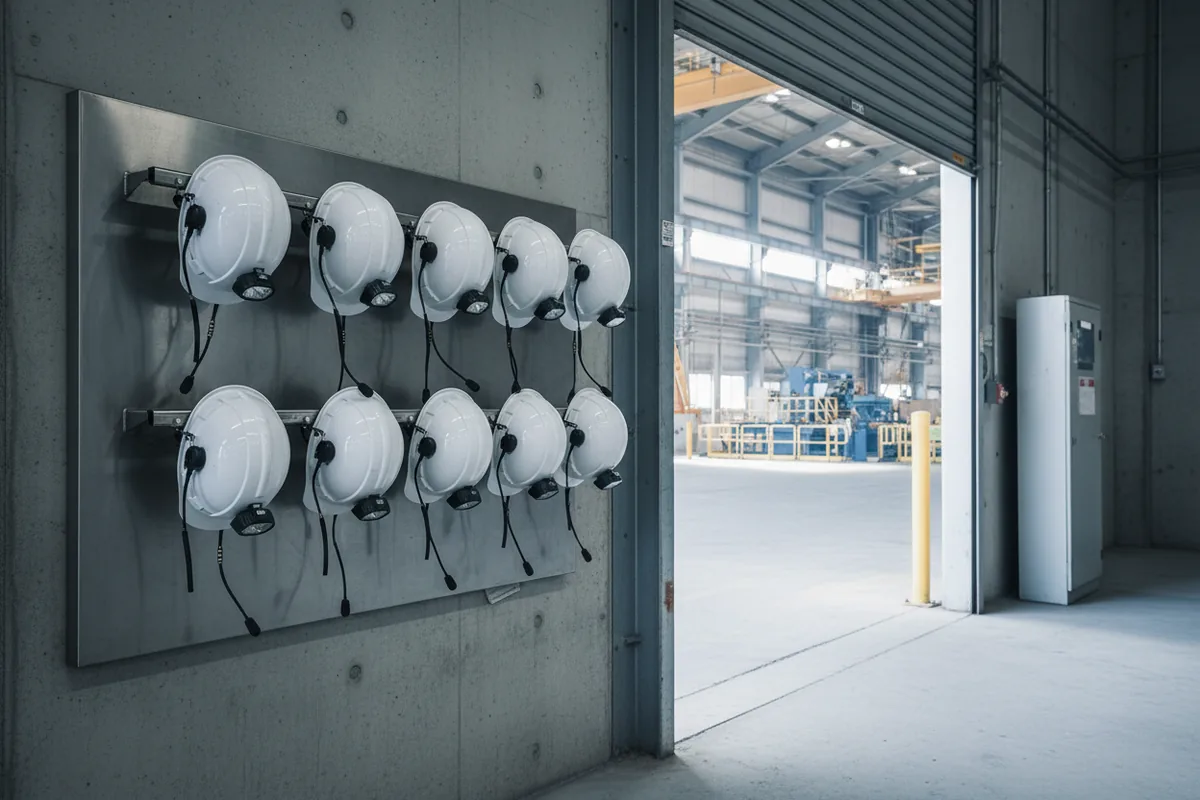
A connected worker platform is software, paired with devices, that gives frontline workers digital work instructions, checklists, safety procedures and live data at the point of work. It also sends information back from the floor. Each completed step, logged deviation or flagged problem reaches supervisors, quality systems and maintenance queues.
On this page
- What a Connected Worker Platform Does on the Plant Floor
- How Connected Worker Technology Changes Day-to-Day Operations
- Infrastructure, Integration, and Compatibility Requirements
- Comparing Platform Approaches: What the Market Offers
- Procurement and Evaluation Considerations
- Frequently asked questions
- Sources
What a Connected Worker Platform Does on the Plant Floor
The platform sits between the worker and the plant's other systems. It is not a scheduling system or an asset database. It is the interface a person uses while doing a task, and it records how that task was done.
Several adjacent software categories cover different ground:
- MES (Manufacturing Execution System): software that manages production scheduling, order tracking and material flow at the plant level.
- CMMS (Computerized Maintenance Management System): software that holds asset records, maintenance schedules and work orders.
- ERP (Enterprise Resource Planning): the business system for orders, inventory, purchasing and finance.
- Connected worker platform: the worker's task interface. It guides the work and captures how it was performed.
Platforms in this category typically group their capabilities into these areas:
- Digital work instructions and guided procedures, with steps, images, video and decision logic
- Skills and training tracking tied to individual workers
- Safety checklists completed at the task
- Anomaly capture, where a worker logs a defect, a deviation or an equipment problem
- Two-way communication between the floor and supervision
Delivery runs through mobile devices such as tablets and smartphones, through wearables and augmented reality (AR) headsets, or through fixed terminals near a machine's HMI (human-machine interface, the operator screen on a machine or line). The choice of device shapes the deployment. A headset program carries different hardware, charging, hygiene and support needs than a shared tablet at each station.
The "connected" part is the return path. A system that only displays instructions is a digital binder. A connected worker platform sends data from the worker's actions to the people and systems that act on it.
How Connected Worker Technology Changes Day-to-Day Operations
The worker's task changes first. Paper binders and verbal handoffs give way to step-by-step guidance on a screen, with embedded photos, video and branching logic for decisions. Less of the procedure depends on what an experienced operator happens to remember and pass on.
For supervisors, task completion, logged deviations and skills gaps can be seen on a dashboard instead of being collected by walking the floor. For quality and safety functions, digital records replace paper sign-offs. A deviation is captured when it occurs, not discovered later in an audit or a records review.
Integration determines how much of this value reaches the rest of the plant. A platform that does not connect to the plant's MES, ERP or CMMS becomes a separate data store, and someone has to move information between systems by hand. For that reason, how deeply a platform integrates is one of the main criteria buyers use to evaluate it.
Training records show where a platform's role stops. OSHA's Control of Hazardous Energy (Lockout/Tagout) page states that the standard for general industry (29 CFR 1910.147) "establishes the employer's responsibility to protect workers from hazardous energy." It also states that employers are required to train each worker so that they know, understand and are able to follow the applicable provisions of the hazardous energy control procedures. The same page states that workers must be trained in the purpose and function of the energy control program.
A connected worker platform can deliver that training and keep a record of it. The requirement itself rests with the employer and the employer's energy control program, not with any software. OSHA's text is what governs how the requirement applies to a particular site.
Support for adopting new technology is also available outside the vendor relationship. NIST's Manufacturing Extension Partnership page describes the MEP National Network as a public-private partnership that helps small and medium-sized manufacturers grow, make operational improvements and reduce risk. The page states that any manufacturer can use the services of MEP Centers, which are located across the U.S. and in Puerto Rico.
For a plant weighing this kind of platform, these operational shifts are the starting point. Each one only holds up if the infrastructure under it does.
Infrastructure, Integration, and Compatibility Requirements
From a buyer's point of view, the features in a demo matter only if the plant can carry them. Network coverage comes first. Live data capture needs a connection wherever work happens, whether through Wi-Fi, private LTE or 5G, or wired access points. A dead zone in a press bay or a cold storage area works like a page torn out of a logbook: the work still happens, but the record of it has a gap.
Devices raise a practical question early on: who buys, sets up, updates and replaces them. A bring-your-own-device (BYOD) model and company-issued hardware lead to very different amounts of IT work and different security policies, so the answer shapes both the budget and the IT workload.
The way a platform connects to other systems matters because it decides how much work falls on the plant after the contract is signed. There are three common routes, and each one tells a buyer something different:
- REST APIs are a standard web-based method for one application to request data from another. They are the usual route to business systems such as an ERP or a CMMS. When a vendor relies on them, the practical question is whether the connection already exists or has to be built.
- OPC UA is an industrial communication standard for machine and system data. It matters when the platform needs to read what equipment is doing, for example to show a machine's status next to the instruction a worker is following.
- Direct database connectors read from or write to another system's database. They can be a quick route, but they tie the platform to how that other system stores its data, which can matter when either system is updated.
Each vendor can state which systems it has pre-built connectors for and which ones require custom integration. That distinction is where much of the difference between two similar-looking proposals tends to sit. A connector that already exists is part of the product. A custom connection is a project, with its own cost and its own upkeep.
Access control comes next. That covers single sign-on (SSO, one login across systems), role-based access, and how the platform handles shared devices when one shift hands over to the next.
OT security is part of the scope. OT, or operational technology, means the control systems and networks that run physical equipment. A platform that touches the plant network sits at the boundary between IT and OT, much like a door between an office and the production floor. NIST's Cybersecurity Framework page presents CSF 2.0 as a framework "for industry, government, and organizations to reduce cybersecurity risks." The framework is voluntary guidance that a plant can use to organize how it manages that boundary. Using it is not a credential of any kind.
Two more checks round out the picture, and both come down to what happens on an ordinary shift:
- Offline behavior: whether the platform keeps working when connectivity drops, and how it reconciles data once the connection returns. On a floor with uneven coverage, this decides whether records stay complete.
- Language support: whether the interface supports multiple languages and icon-driven guidance for a workforce with mixed languages and reading levels. Instructions only help if every worker can follow them.
Comparing Platform Approaches: What the Market Offers
Platforms differ along four main axes. Comparing them on those axes, rather than by brand, keeps the evaluation tied to the plant's own requirements.
Deployment model: The real question here is who carries the upkeep and what the plant depends on.
- With cloud-hosted SaaS (software as a service, run and maintained by the vendor), the vendor handles upkeep, and the plant depends on dependable connectivity.
- With on-premises deployment, the software runs on the plant's own servers. The plant decides where data is stored and when updates happen, and in exchange it takes on the infrastructure and maintenance work.
- Hybrid models split workloads between the vendor's cloud and the plant's servers, and split those trade-offs with them.
Functional depth: A point solution handles digital work instructions alone. A full-suite platform adds skills tracking, safety tools, analytics and maintenance triggers.
Integration architecture: Open-API platforms reduce dependence on a single vendor but require more integration work. Closed ecosystems may deploy faster inside one vendor's set of products, with less flexibility outside it.
Industry focus: Some platforms are built for discrete manufacturing, some for process industries, and some for field service. Fit follows the plant's own workflow patterns.
A shared criteria table keeps proposals comparable. Filling each cell from the vendor's written documentation, rather than from notes taken in a sales conversation, gives every vendor the same yardstick.
| Criterion | What to record from each vendor's documentation |
|---|---|
| Deployment model | Cloud-hosted SaaS, on-premises, or hybrid |
| Integration depth | Pre-built connectors listed by system name; what requires custom work |
| Offline capability | Functions available offline; how data syncs on reconnection |
| Device support | Tablets, smartphones, wearables, AR headsets, fixed terminals |
| Language support | Languages offered; whether icon-based guidance is available |
| Analytics depth | Reports and dashboards included as standard |
| Vendor support model | Who makes configuration changes after go-live; what the service agreement covers |
Procurement and Evaluation Considerations
Scope comes before the RFQ. An RFQ that does not state the number of workers, shifts, sites and languages, and the specific workflows to be digitized, tends to produce proposals that cannot be compared side by side.
Total cost of ownership (TCO) is the full cost of a system over the time it is in use. For a connected worker platform it has these parts:
- Licensing or subscription fees
- Implementation and configuration
- Device hardware
- Integration development
- Training
- Ongoing support
Each vendor can be asked to price these separately in its written proposal. Pricing structure, contract length and implementation timeline vary by vendor and by scope, so they belong in the written proposal as well, where they can be read against the same scope for every vendor.
Adoption deserves its own line in the evaluation. A platform changes how workers receive instructions and record their work, and if the people on the floor do not trust it or find it slower than paper, the records it was meant to produce stay incomplete. How a vendor supports workers and supervisors through that change says as much about a deployment's prospects as the feature list does.
Points to raise with each vendor:
- Ask about pilot scope. Find out what a limited pilot on one line or one shift covers and what data it produces.
- Ask about the support model. Confirm who handles configuration changes after go-live, what the service level agreement covers, and whether implementation staff work in the plant's region.
- Ask about data ownership. Confirm who owns the work instruction content and the captured data, and what happens to both if the contract ends.
- Ask about change management. Find out what onboarding and adoption support the vendor provides for workers, since adoption is a frequent point of failure in deployments.
- Ask about commercial terms. Find out how pricing is structured, what contract length is proposed, and what implementation timeline the vendor sets out for the defined scope.
A practical next step is a short list of the first workflows to digitize, such as lockout/tagout procedure training, quality inspection steps or changeover sequences, along with a record of the systems each workflow touches today.
Independent referral
Your next project deserves a clearer starting point.
Describe your requirements. Where there is a fit, we may introduce you to relevant providers.
Industrial Technology Exchange
How the independent referral process works
- DescribeSubmit a short inquiry describing your project, facility and timeline.
- ReviewWe review the inquiry for clarity and fit. Incomplete or out-of-scope requests may not be referred.
- ConnectWith your consent, relevant third-party providers may contact you. You decide whether to engage.
Testimonials
Frequently asked questions
What is a connected worker?
A connected worker is a frontline employee whose tasks, training records and status are linked to plant systems through a digital device or a wearable. The link runs both ways: the worker receives digital guidance, and the plant receives data from the worker's actions.
What are connected factories?
A connected factory links machines, sensors and workers into a shared data environment, so production status, quality signals and maintenance needs are visible as they happen. A connected worker platform is the layer of that environment focused on people, not on data passed between machines.
What are digital workplace services in a manufacturing context?
In manufacturing, the term refers to software that supports frontline workers at the point of work: work instructions, skills tracking, safety checklists and communication tools. A connected worker platform is one category within that broader set.
How does a connected worker platform differ from an MES?
An MES manages production scheduling, order tracking and material flow for the plant. A connected worker platform handles the individual worker's tasks: it delivers instructions, captures deviations and records completed steps. When the two are integrated, the MES often supplies the job context and the platform captures how the work was executed.
Does a connected worker platform satisfy OSHA's lockout/tagout training requirement?
No. OSHA's lockout/tagout page states that employers are required to train each worker in the hazardous energy control procedures. A platform can deliver and document that training, but the employer's energy control program is what the standard addresses.
What integration work is typically required to deploy a connected worker platform?
It depends on which systems the platform exchanges data with, such as the MES, ERP, CMMS and quality systems. Pre-built connectors reduce the integration work. Custom API development adds to the implementation scope. A vendor's proposal can list integration work separately from licensing.
What is the difference between a cloud-hosted and an on-premises connected worker platform?
The practical difference shows up in who does the work and what the plant depends on. With a cloud-hosted platform, the plant's reliance shifts to its own network: if connectivity on the floor is uneven, the offline behavior of the platform becomes a deciding factor. With an on-premises platform, the plant's IT staff carry the servers and updates, so the question becomes whether that staff time is available. A hybrid model divides both sets of questions.
How should a manufacturer evaluate connected worker platform vendors?
Compare vendors on deployment model, integration depth, offline capability, device support, language options, analytics depth and support model. An RFQ that defines the workflows, the systems already in place, and the number of workers and sites produces proposals that can be measured against the same criteria.