

The decision in front of you is rarely "whether" to test. It is which mix of software, outside testing and in-house procedure matches your products, your regulators and the systems your plant already runs. The answer starts with the requirements your products carry, then moves to how measurement data is captured, recorded and kept, and only then to which kind of provider fits that scope.
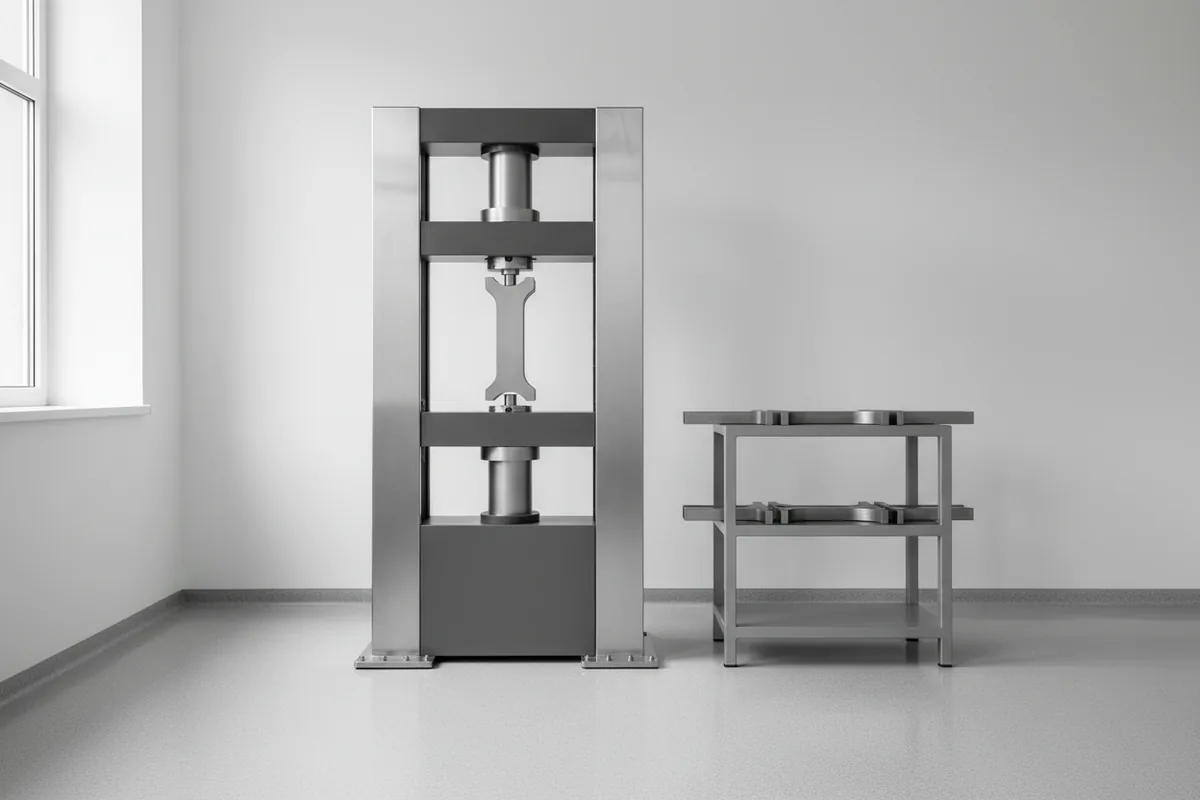
For a plant engineer or operations manager scoping a quality program, quality testing and compliance means two linked things. Testing is inspecting, measuring and checking products or processes against defined specifications. Compliance is conforming to the regulatory, industry or customer requirements that apply. Together they produce the documented evidence that a product meets its requirements.
On this page
- Key Takeaways for Quality Testing and Compliance
- Which Facilities and Operations Quality Testing and Compliance Serves
- How Quality Testing and Compliance Programs Work in a Manufacturing Setting
- Quality Testing and Compliance Options and How They Differ
- How to Evaluate a Quality Testing and Compliance Provider
- What Drives the Cost of Quality Testing and Compliance
- When Quality Testing and Compliance Solutions Are Not the Right Fit
- Questions to Ask Before Selecting a Quality Testing and Compliance Solution
- Frequently asked questions
- Sources
Key Takeaways for Quality Testing and Compliance
- Frameworks differ by industry. U.S. manufacturers encounter ISO 9001 for quality management systems, FDA 21 CFR Part 820 for medical device manufacturers, OSHA workplace safety requirements and EPA environmental requirements, among others; which ones apply depends on the products and markets.
- Measurement reliability rests on traceability. Each measurement result needs a documented link back to reference standards, as NIST's Policy on Metrological Traceability describes.
- Related disciplines have their own scope. Calibration and nondestructive testing are related to quality testing but are distinct disciplines.
- No single approach fits every plant. The right solution depends on the facility's industry, the frameworks that apply, the products being tested and the systems already in place.
Which Facilities and Operations Quality Testing and Compliance Serves
Formal quality testing and compliance programs appear across several manufacturing sectors:
- Discrete manufacturing, such as automotive, aerospace and electronics.
- Process manufacturing, such as food and beverage, chemicals and pharmaceuticals.
- Medical device manufacturing, which operates under FDA oversight.
- Industrial equipment production, where parts and assemblies are built to customer specifications.
Certain operating conditions point toward a structured program: high-volume production with tight dimensional tolerances, regulated products with mandatory documentation, supply chains that require supplier qualification, and facilities pursuing or maintaining conformance to ISO 9001 or a sector-specific standard.
FDA-regulated manufacturers carry an extra layer for electronic records. The FDA's guidance on Part 11, Electronic Records; Electronic Signatures states that 21 C.F.R. Part 11 "applies to records in electronic form that are created, modified, maintained, archived, retrieved, or transmitted under any records requirements set forth in Agency regulations." The guidance calls the underlying record requirements in the statutes and other FDA regulations "predicate rules." In plain terms, if an FDA rule already requires a record and your plant keeps that record electronically, Part 11 comes into play for it.
Regulatory frameworks are revised over time, and medical device requirements under FDA 21 CFR Part 820 are among those a buyer researching current rules would read in their current text, as the FDA publishes it, rather than in a vendor's summary.
Scope matters as much as industry. Some facilities need a full quality management system (QMS), meaning the documented procedures, records and workflows that govern quality across the operation. Others need a targeted capability, such as inspection at one production stage or testing of one material. Which of the two your plant needs shapes every choice that follows.
How Quality Testing and Compliance Programs Work in a Manufacturing Setting
A quality program follows material from the receiving dock to the shipping dock, with records at each stage.
Step 1: Incoming inspection
Raw materials and purchased components are checked against their specifications before they enter production. Results feed supplier records, which support supplier qualification.
Step 2: In-process inspection
Measurements are taken at defined production stages. Data is captured by manual gauging, coordinate measuring machines (CMMs, which measure part geometry with a probe), automated vision systems, or statistical process control (SPC) software, which tracks process data over time to show when a process drifts.
Step 3: Final inspection
Finished goods are checked against the product specification before release.
Step 4: Corrective and preventive action
Corrective and preventive action (CAPA) is the documented process for investigating a nonconformance, correcting its cause and preventing a repeat.
Measurement traceability and records
Every measurement in these steps is only as sound as the instrument behind it. NIST adopts the definition of metrological traceability as a "property of a measurement result whereby the result can be related to a reference through a documented unbroken chain of calibrations, each contributing to the measurement uncertainty," according to its traceability policy. For a plant, that means a gauge reading counts as traceable only when the calibration records connect it, step by step, back to a recognized reference. NIST states that supporting a traceability claim is the responsibility of the provider of the result, and that assessing the claim's validity is the responsibility of the user of that result. Put simply, a calibration lab backs up its claim, and your plant decides whether that backing holds up.
In FDA-regulated plants, records carry their own controls. The FDA's Part 11 guidance recommends deciding in advance, for each record required under predicate rules, whether the electronic or paper record will be relied on, and documenting that decision, for example in a Standard Operating Procedure. In practice, a plant that prints reports but works from the screen settles, in writing, which version is the record of truth. The FDA states that audit trails "can be particularly appropriate when users are expected to create, modify, or delete regulated records during normal operation." That points audit trails toward the records your staff edit day to day.
Integration with plant systems
Integration ties the program to the rest of the plant: enterprise resource planning (ERP) software for nonconformance tracking and supplier records, a manufacturing execution system (MES), the software that tracks work on the plant floor, for in-process data, and a computerized maintenance management system (CMMS) for calibration scheduling. Integration capability varies by platform, and a QMS that cannot connect to these systems leaves staff entering data by hand, which adds error risk and reduces the value of the system. How far a solution connects to them also affects implementation scope and cost.
Quality Testing and Compliance Options and How They Differ
Three broad categories make up the market a buyer meets, and many plants combine them.
| Option | What it does | Who owns the work | Where it tends to fit |
|---|---|---|---|
| QMS software platform | Manages documents, nonconformances, CAPA and audit trails | The facility's own staff, using vendor software | Plants needing a documented system across lines or sites |
| Third-party testing and inspection services | Performs physical or chemical testing on products or materials | The outside laboratory | Testing that needs equipment or methods the plant does not hold |
| In-house program development | Writes procedures, trains staff, builds internal audit capability | The facility, sometimes with outside help | Plants building or rebuilding a quality system's foundation |
QMS platforms differ from one another mainly in deployment, which can be cloud-hosted or on-premise, and in the frameworks they are designed around, such as ISO 9001, FDA 21 CFR Part 820, AS9100 for aerospace or IATF 16949 for automotive.
Third-party laboratories may hold accreditations to specific standards. The scope of an accreditation is what counts: a lab's accreditation covers named standards and methods, and that scope has to match the products and tests a buyer needs.
Hybrid approaches are a fourth path in practice. A facility may run QMS software for documentation and CAPA while contracting outside labs for specific physical or chemical tests. The combination follows from the frameworks that apply, the volume and variety of products, and the systems in place.
How to Evaluate a Quality Testing and Compliance Provider
Four criteria give a provider comparison a firm base:
- Regulatory scope. Which frameworks the solution or service explicitly supports, in its own documentation.
- Integration capability. Which plant systems the provider has documented integrations with.
- Validation support. Whether the provider supports IQ/OQ/PQ validation in regulated environments. Installation qualification (IQ) confirms a system is installed as specified, operational qualification (OQ) confirms it operates as intended, and performance qualification (PQ) confirms it performs in actual use.
- Industry references. Whether the provider can point to customers in your industry.
For FDA-regulated buyers, a QMS vendor's documentation can be read against the FDA's Part 11 guidance. That guidance states that the FDA intends to exercise enforcement discretion on specific Part 11 audit-trail requirements, while "persons must still comply with all applicable predicate rule requirements related to documentation of, for example, date ... time, or sequencing of events," according to the FDA's guidance page. The practical reading: relaxed enforcement on some audit-trail details does not relieve a plant of recording when things happened and in what order. The same guidance recommends basing validation decisions on "a justified and documented risk assessment," which means the depth of validation follows from how much a system can affect product and records, and that reasoning is written down. How those points apply to a given plant is a matter between the manufacturer and the FDA, not something a vendor's brochure decides.
For measurement-intensive operations, the provider's approach to metrological traceability is a concrete technical criterion. NIST also states that traceability alone does not signify fitness for purpose, because that typically requires measurement uncertainty small enough for the particular need. A traceable instrument can still be too coarse for a tight tolerance.
A provider that claims coverage of every framework without asking about the facility's requirements is a signal to probe further; scope belongs in writing before a contract is signed. For QMS software, a pilot or proof-of-concept phase tests the system against a defined set of use cases, which lets integration gaps surface before full deployment.
What Drives the Cost of Quality Testing and Compliance
The provider's written proposal or quote states the actual cost. What a buyer can control is how clearly the scope is defined before asking for one.
The primary drivers:
- Coverage. The number of facilities and production lines included.
- Regulatory load. The frameworks that require validation or documentation; FDA-regulated environments carry more documentation work.
- Integration depth. How far the solution connects to existing plant systems.
- Testing mix. Whether third-party testing services are included or the work stays in-house.
QMS software is typically priced by deployment model (a cloud subscription or a perpetual license), the number of users or modules, and how much implementation and validation support is included.
Third-party testing costs turn on the type of test (dimensional, chemical, mechanical or environmental), the volume of samples, turnaround requirements, and whether the lab holds accreditation to the specific standard required.
Total cost of ownership (TCO) is the full cost over the life of the program, not only licensing or service fees. It includes internal labor for system administration, calibration scheduling and audit preparation. A proposal that looks lean on fees may shift that labor onto your staff, so TCO is the fairer basis for comparing options.
When Quality Testing and Compliance Solutions Are Not the Right Fit
A full QMS software platform can be premature. A very small operation with a single product line and no regulatory mandate may find that a documented procedure set and a spreadsheet-based nonconformance log carry it until volume or regulatory exposure grows.
Testing programs also depend on what comes before them. A facility without defined product specifications or process parameters has nothing firm to test against; specification development precedes testing program design.
Outside testing has limits too. Where a framework that applies to a facility calls for documented control of its own manufacturing process, an outside lab's test reports do not stand in for the facility's own quality system. What is required comes from the framework itself and the agency that runs it.
Integration readiness on the facility's side is the last condition. Where existing systems are not ready to connect, the realistic set of software options narrows, which is why readiness is worth assessing before a vendor is selected.
Questions to Ask Before Selecting a Quality Testing and Compliance Solution
Each of these questions ties to a criterion a provider can answer in writing:
- Which regulatory frameworks does your solution explicitly support, and can you show documentation of how your system addresses each requirement?
- What ERP, MES and CMMS platforms does your system have documented, tested integrations with, and what does the integration project involve on our side?
- For FDA-regulated buyers: how does your system's audit trail and electronic signature functionality align with the FDA's Part 11 guidance?
- For measurement-intensive operations: how does your calibration management module maintain and document metrological traceability, as NIST defines it?
- What does implementation include (configuration, data migration, validation support and training), and what are we, as the buyer, expected to provide?
- What does the contract cover for ongoing support, system updates and regulatory change management when a framework is revised?
- Can you provide reference customers in our industry and of our facility size who have gone through implementation?
A practical starting point is a list of the regulatory frameworks that apply to your facility's products and markets, marked with which of them call for documented quality system elements. That list turns these questions from general to specific.
Independent referral
Your next project deserves a clearer starting point.
Describe your requirements. Where there is a fit, we may introduce you to relevant providers.
Industrial Technology Exchange
How the independent referral process works
- DescribeSubmit a short inquiry describing your project, facility and timeline.
- ReviewWe review the inquiry for clarity and fit. Incomplete or out-of-scope requests may not be referred.
- ConnectWith your consent, relevant third-party providers may contact you. You decide whether to engage.
Testimonials
Frequently asked questions
What is testing in quality assurance?
Quality assurance testing is the structured measuring, inspecting or checking of products, materials or processes against defined specifications or standards to determine whether they conform. It spans incoming, in-process and final inspection, and it produces the documented evidence a quality system relies on.
If a product fails to meet quality standards, what is the most appropriate action for a quality assurance technician to take?
The facility's documented nonconformance procedure governs the specific steps. In general, the nonconforming product is held apart, the nonconformance is recorded in the quality system, a disposition decision follows, and a CAPA process is opened if the failure points to a systemic cause.
What regulatory frameworks apply to quality testing and compliance in U.S. manufacturing?
It depends on the products and markets. ISO 9001 is a quality management system standard; FDA 21 CFR Part 820 applies to medical device manufacturers; OSHA sets workplace safety requirements and EPA environmental requirements. AS9100 for aerospace and IATF 16949 for automotive are sector-specific standards. A facility's products, markets and customers determine which apply.
What is metrological traceability and why does it matter for quality testing?
It is the ability to tie a measurement result back to a recognized reference through documented calibrations. It matters because it gives each reading a defensible basis. NIST places responsibility for supporting a traceability claim on the provider of the result, and for assessing it on the user.
What does a quality management system (QMS) software platform do?
A QMS platform manages the documentation, records and workflows a quality system uses: document control, nonconformance tracking, CAPA, audit management, supplier qualification records and training records. In FDA-regulated environments, it also holds the audit trails and electronic signature controls that 21 C.F.R. Part 11 addresses.
How does FDA Part 11 affect quality testing software for medical device manufacturers?
When software holds records that FDA rules already require, Part 11 reaches those records, according to the FDA's guidance. The guidance is nonbinding and recommends risk-based, documented decisions on validation and audit trails.