
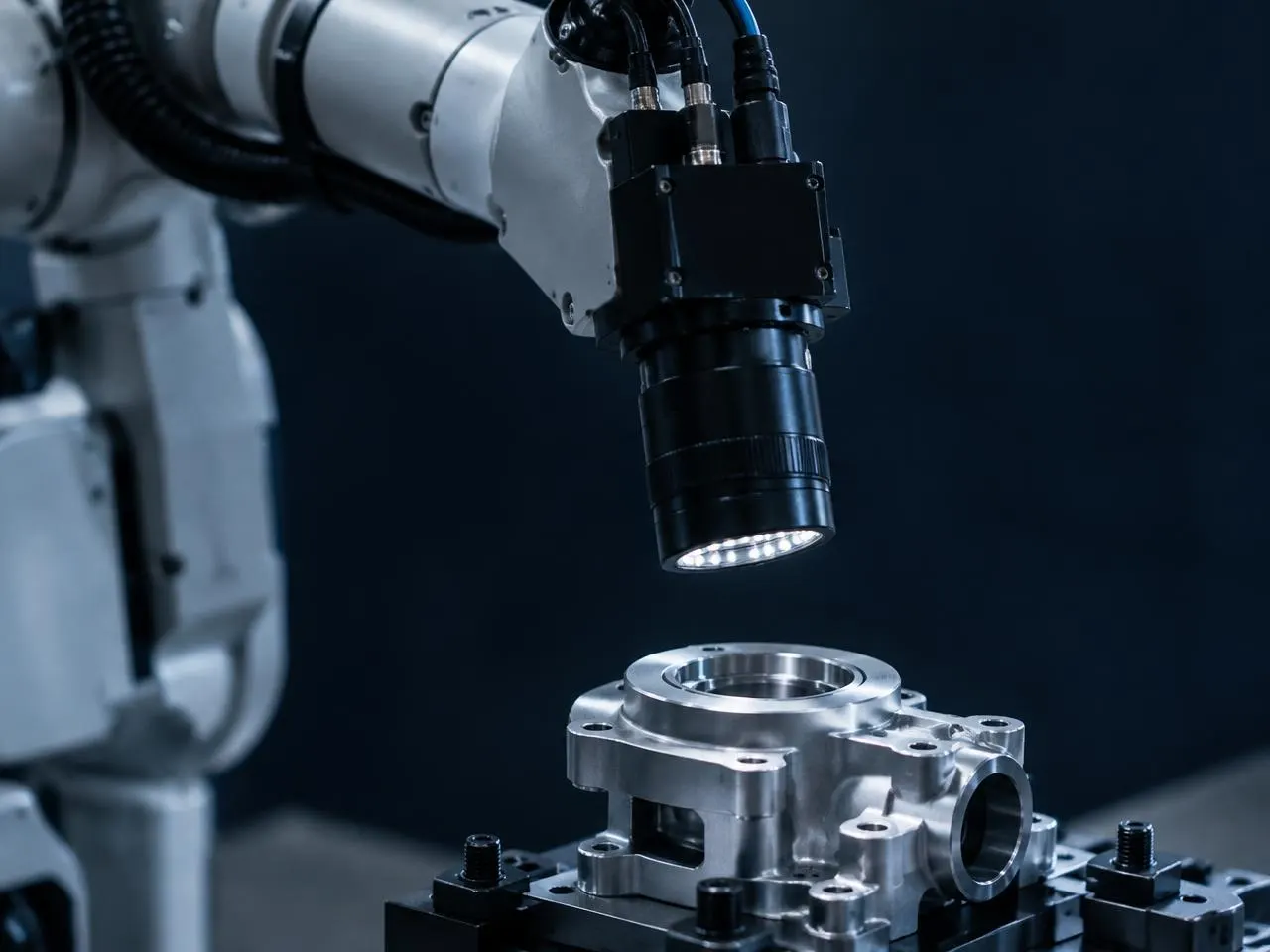
You may be a plant engineer scoping a cell, an operations manager looking at an inspection bottleneck, or a buyer preparing an RFQ, which is a request for quotation. In each role, the work is the same: define the task, the part and the systems the new equipment must connect to, and then compare how providers propose to deliver it. The decisions that shape a robotics or vision project are technical and commercial at once. They cover what the robot or camera must do, how it connects to the plant's controls and software, how the cell is guarded, and what it costs to run over its life.
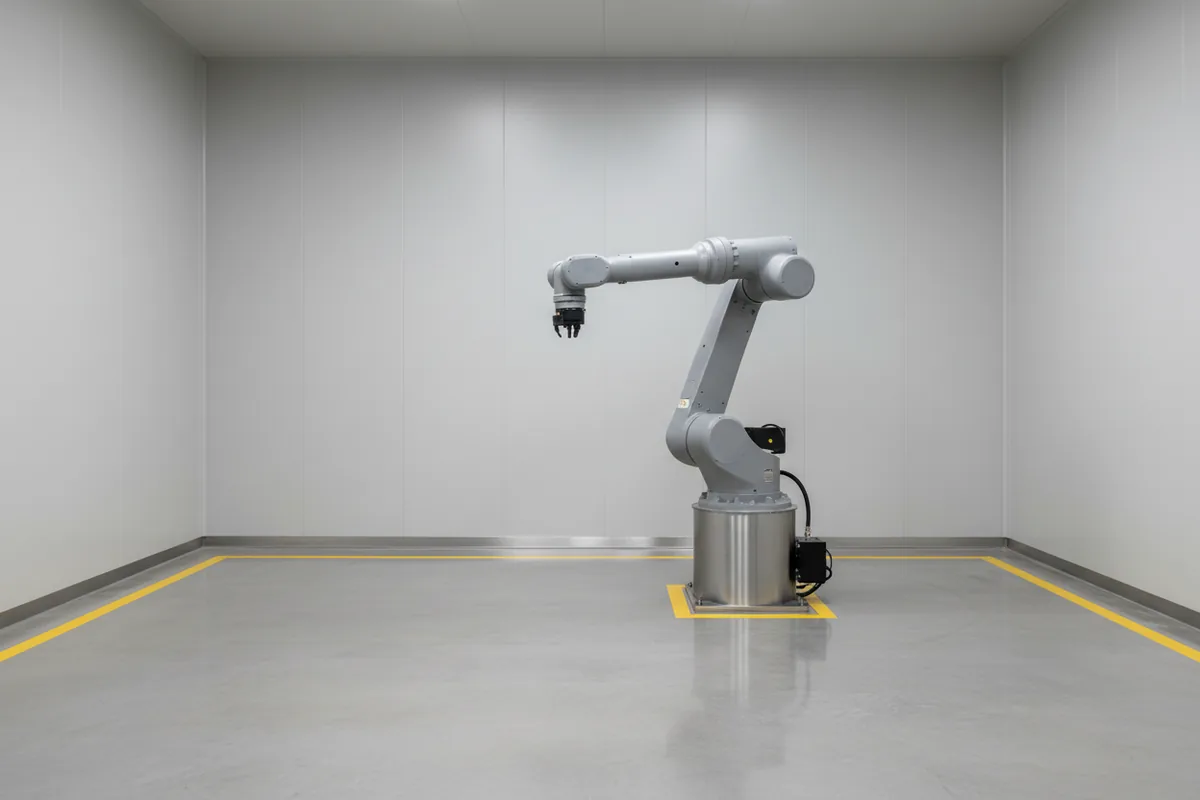
Robotics and machine vision automate physical work and visual judgment on a production line. Industrial robots move parts, tools and material through programmed motions. Machine vision systems use cameras, lighting and software to locate, inspect, identify and measure parts. The two technologies are often paired, but each does a distinct job, and each can stand alone.
On this page
- Key Takeaways for Robotics and Machine Vision Projects
- Which Operations and Facilities Robotics and Machine Vision Fit
- How Industrial Robots and Machine Vision Systems Work
- Robotics and Machine Vision Options and How They Differ
- How to Evaluate a Robotics or Machine Vision Provider
- What Drives the Cost of a Robotics or Machine Vision Project
- When Robotics or Machine Vision May Not Be the Right Fit
- Questions to Ask Before Requesting a Quote
- Frequently asked questions
- Sources
Key Takeaways for Robotics and Machine Vision Projects
- Two technologies, two jobs. Robots automate physical tasks. Vision gives robots and lines the ability to inspect, identify, measure and guide.
- Broad application range. Together they span welding, assembly, pick-and-place, quality inspection and material handling.
- The main decision variables. These are the application type, payload and reach, vision resolution and lighting, integration with existing controls and software, and site conditions.
- No robotics-specific OSHA standard. OSHA's Robotics page states that there are currently no specific OSHA standards for the robotics industry.
- General federal duties still apply. Under 29 U.S.C. § 654(a), each employer must furnish employment and a place of employment free from recognized hazards that are causing or are likely to cause death or serious physical harm to its employees. Each employer must also comply with occupational safety and health standards issued under that chapter.
- Machine guarding is a federal requirement. Under 29 C.F.R. § 1910.212(a)(1), one or more methods of machine guarding must be provided. The guarding protects the operator and other employees in the machine area from hazards such as those created by the point of operation, ingoing nip points, rotating parts, flying chips and sparks.
- No outcome is promised. Savings, uptime and schedule are not assured by any technology. A provider's written proposal is where fit, scope, price and commitments for a specific application are stated.
Which Operations and Facilities Robotics and Machine Vision Fit
The clearest fit for an industrial robot is a high-volume, repetitive task performed on parts with consistent geometry. OSHA's Robotics page describes industrial robots as programmable multifunctional mechanical devices that move material, parts, tools or specialized devices through variable programmed motions. According to that page, robots are generally used for unsafe, hazardous, highly repetitive and unpleasant tasks. The page names functions including material handling, assembly, welding, machine tool load and unload, painting and spraying.
Machine vision fits inspection work in three situations: where human visual inspection slows the line, where defect rates matter, or where each part needs a recorded result for traceability.
A cobot, short for collaborative robot, is designed to work in a space shared with people at lower force and speed. Cobots fit lighter tasks where a person and the robot work side by side.
Two kinds of vehicle handle material transport inside a facility. An AMR (autonomous mobile robot) uses onboard sensors to plan and adjust its route. An AGV (automated guided vehicle) follows a fixed path, such as a guide wire or floor marking.
The fit is weaker in certain facilities: those with a highly variable part mix, very small batches, or infrastructure that cannot support integration. Robotic welding and robotics integration are related scopes that build on the same foundations.
How Industrial Robots and Machine Vision Systems Work
A robotics or vision system is a chain of hardware, sensing and software. Each link in that chain shapes what the system can do. Here is how the parts relate, described as concepts. These descriptions are not instructions for installing, wiring, programming or operating any machine. Those tasks belong to the equipment maker's documentation and to qualified personnel.
Step 1: The robot's mechanical type sets its motion
Industrial robots come in four main mechanical types:
- Articulated robots use rotary joints in series, like an arm, and can reach around obstacles.
- SCARA robots (selective compliance assembly robot arm) move rigidly in the vertical direction and flexibly in the horizontal plane, which suits assembly and pick-and-place work.
- Delta robots hang parallel arms from overhead and suit light, fast picking.
- Cartesian robots (gantry robots) move along straight linear axes and suit large rectangular work areas.
Step 2: Axes of motion define reach and workspace
Each axis is one independent direction of movement. The number and arrangement of axes determine how far the robot reaches, which orientations it can hold, and the shape of its working envelope. The working envelope is the space the robot can sweep.
Step 3: End-of-arm tooling meets the part
End-of-arm tooling (EOAT) is the gripper, vacuum cup, torch or other device mounted on the robot's wrist. It is the interface between the robot and the part, and it is often custom-designed for each part.
Step 4: The vision system captures and interprets images
A machine vision system combines a camera, a lens, lighting, an image processor and software. An area scan camera captures a full two-dimensional frame at once. A line scan camera builds an image one row at a time as the part or the camera moves, which suits continuous material and long parts. Lighting design often decides whether a feature can be seen reliably at all.
Step 5: Vision guides motion and makes decisions
2D vision locates a part in a flat plane and corrects for its rotation. 3D vision adds depth, so the robot can pick parts lying at varied heights and angles. The same image can also produce a pass or fail decision that diverts a part.
Other sensors complete the picture:
- Proximity sensors detect when a part is present.
- Force/torque sensors measure contact during assembly or finishing.
- Encoders report each joint's position to the controller.
- Safety sensors detect people approaching the cell.
Step 6: Integration connects the cell to the plant
The robot controller usually exchanges signals with a PLC (programmable logic controller), the industrial computer that runs machine logic. An HMI (human-machine interface) is the operator's screen. Vision results can flow to SCADA (supervisory control and data acquisition), which monitors equipment across a site, or to an MES (manufacturing execution system), which tracks production and keeps traceability records.
Robotics and Machine Vision Options and How They Differ
The main choices in a robotics or vision project fall into three pairs: the deployment model, the robot class and the vision architecture. Each is compared here on general characteristics, without reference to any vendor's product.
| Option | Generally suited to | Main trade-off |
|---|---|---|
| Standalone robot cell | One defined task with its own footprint and guarding | Simpler integration, but material moves in and out separately |
| Integrated line | Several linked stations sharing conveyors and controls | Deeper integration and more involved changeover |
| Fixed industrial robot | Higher speed and payload behind guarding | More guarding and more formal programming |
| Cobot | Lower force and speed in shared space | Less speed and payload in exchange for working near people |
| 2D vision | Location, presence or absence, and surface checks | Lower processing load, but no depth data |
| 3D vision | Bin picking, volume and complex surfaces | More processing power and more lighting design |
| Smart camera | Self-contained imaging and processing in one unit | Simpler setup, but less processing headroom |
| PC-based vision | Multiple cameras and heavier algorithms | More flexibility, but more integration work |
The fixed robot and the cobot differ in four ways: speed, payload, safety fencing needs and programming approach. Which approach fits a given cell commonly depends on the task and on the risk assessment for that cell, and providers typically explain the approach they recommend and the reasoning behind it.
Connectivity adds one more layer. IIoT, the Industrial Internet of Things, means networked sensors and devices that send machine data to plant or cloud software. Through that connection, a vision system can feed inspection results, images and counts to an MES. It can also feed a digital twin, which is a software model of a machine or line that is kept current with real data.
How to Evaluate a Robotics or Machine Vision Provider
A provider evaluation tests three things: whether the provider can deliver your specific application, whether it can connect to your systems, and whether it can support the cell after startup. The same criteria apply whether the provider is an integrator, a machine builder or an equipment supplier.
The first questions concern experience and fit with the plant. Application experience asks whether the provider has deployed this robot type or vision architecture in your industry and at a similar production volume. Integration depth asks whether it connects directly to your PLCs, HMIs, SCADA, MES and ERP, or whether a separate integration layer is required. ERP (enterprise resource planning) is the business system that handles orders, inventory and finance.
Safety questions come next, and here the federal text frames the discussion. Useful points to raise include what guarding design and risk assessment documents the provider supplies. Under 29 C.F.R. § 1910.212(a)(2), guards must be affixed to the machine where possible and secured elsewhere if attachment is not possible, and a guard must not itself create an accident hazard. The duties in 29 U.S.C. § 654(a) rest with each employer, so a provider's design does not by itself make a plant safe or compliant. Lockout coordination matters as well: under 29 C.F.R. § 1910.147(f)(2), when outside servicing personnel do work within the scope of that standard, the on-site employer and the outside employer must inform each other of their lockout or tagout procedures.
The remaining questions look past installation to the life of the cell:
- Commissioning scope. Commissioning is the testing and startup that brings a system to working condition at your site. The question is what the provider's scope of work covers through startup and acceptance.
- Ongoing support. This covers spare parts availability, remote diagnostics and retraining.
- Total cost of ownership. Total cost of ownership (TCO) is the full cost over a system's life, beyond the purchase price. The question is which cost categories the provider's proposal itemizes.
- OT security. Operational technology (OT) security is the protection of control systems and plant networks. The question is how networked robot controllers and vision systems are segmented, accessed and updated.
What Drives the Cost of a Robotics or Machine Vision Project
The cost of a robotics or vision project is set by its scope, and the quote for your application reflects the choices made in each area of that scope. The equipment itself is the starting point. Robot type, payload class and number of axes shape the capital cost of the arm and its controller. Vision cost rises with 2D versus 3D imaging, the number of cameras, the lighting design and software licensing. End-of-arm tooling adds its own line, since custom grippers and fixtures must be designed and fabricated.
Engineering and safety work sit on top of the hardware:
- Integration scope. Each connection to PLCs, HMIs, SCADA, MES or ERP adds engineering hours.
- Safety guarding. Guarding must be designed and installed to meet the requirements of 29 C.F.R. § 1910.212. Under § 1910.212(a)(3)(ii), point-of-operation guarding must conform to any appropriate standards. In the absence of applicable specific standards, it must be designed and constructed to prevent the operator from having any part of the body in the danger zone during the operating cycle.
- Commissioning, operator training and documentation. Each of these is a separate line of effort in the project.
Costs also continue after startup and depend on the site. Ongoing costs include spare parts, software maintenance and retraining when new part programs are added. Site conditions such as floor flatness, ambient lighting, temperature, vibration and available power can each add preparation work.
Framing these drivers in TCO terms lets you compare proposals line by line rather than on capital price alone.
When Robotics or Machine Vision May Not Be the Right Fit
Some applications make a weaker case for automation, and seeing that early protects a project budget. Fit is judged application by application, and no assessment promises an outcome.
- High mix, low volume or frequent changeover. Each new part can require new tooling, new programs and new vision setups, which narrows the economic case.
- Variable parts. Highly variable geometry, surface finish or part presentation can challenge vision accuracy and gripping.
- Limited infrastructure. Facilities without the electrical capacity, floor space or network connectivity to support integration face added preparation work.
- Unstable processes. Automation amplifies process variation, so a process that is not yet stable may need correcting before it is automated.
In these cases, process improvement, fixturing changes or manual stations with inspection aids may fit instead. Robotic welding raises its own fit questions, separate from general handling and assembly work.
Questions to Ask Before Requesting a Quote
Preparation before supplier conversations means fewer assumptions in the quotes that come back. An RFP, or request for proposal, invites providers to propose an approach, while an RFQ asks them to price a defined scope. Either one works better with these points settled.
- Define the application. Record the part description, the task, the production rate target and the acceptable reject rate.
- List the integration targets. Name the PLCs, HMIs, SCADA, MES, ERP and CMMS the system must connect to. A CMMS (computerized maintenance management system) schedules and records maintenance work.
- State the safety expectations. Specify which risk assessment and guarding documents are expected, framed by the requirements of 29 C.F.R. § 1910.212 and 29 U.S.C. § 654(a).
- Document site conditions. Provide a floor plan, available power and environmental conditions.
- Set support and training expectations. Specify what operator and maintenance training the scope must include.
- State OT security requirements. Describe how networked controllers and vision systems must be segmented and accessed.
The usual next step is assembling the RFQ package itself: part drawings and samples, a production rate target, a list of the controls and software in place, and a site floor plan. With that package in hand, the same questions can go to each provider and the answers can be compared side by side.
Independent referral
Your next project deserves a clearer starting point.
Describe your requirements. Where there is a fit, we may introduce you to relevant providers.
Industrial Technology Exchange
How the independent referral process works
- DescribeSubmit a short inquiry describing your project, facility and timeline.
- ReviewWe review the inquiry for clarity and fit. Incomplete or out-of-scope requests may not be referred.
- ConnectWith your consent, relevant third-party providers may contact you. You decide whether to engage.
Testimonials
Frequently asked questions
What are the main sensors used in industrial robots?
The principal sensor types are proximity, force/torque, vision, encoder and safety sensors. Proximity sensors detect parts, and force/torque sensors measure contact. Vision locates and inspects parts, encoders report joint position, and safety sensors detect people approaching the cell.
What is the difference between a robot and a cobot?
A cobot is designed to share space with people at lower speeds and forces. A traditional industrial robot typically runs at higher speed and payload behind guarding. Which one fits depends on the task and on the cell's risk assessment.
What is machine vision and how does it work with a robot?
Machine vision uses cameras, lighting and image-processing software to locate, inspect or measure parts. Its output tells the robot where a part sits and how it is oriented. The same image can also produce a pass or fail decision that diverts a part from the line.
Does OSHA have a specific standard for industrial robots?
No. OSHA's Robotics page states that there are currently no specific OSHA standards for the robotics industry. The employer duties in 29 U.S.C. § 654(a) and the machine guarding requirements of 29 C.F.R. § 1910.212 still apply as their text states.
What is the difference between an AMR and an AGV?
An AMR uses onboard sensors to plan and adjust its own route. An AGV follows a fixed path, such as a guide wire or floor marking. AMRs suit routes that change, while AGVs suit repeated, fixed routes.
What does machine guarding require for a robot cell?
Under 29 C.F.R. § 1910.212(a)(1), one or more methods of machine guarding must protect the operator and other employees in the machine area. The hazards named include the point of operation, ingoing nip points, rotating parts, flying chips and sparks. Barrier guards, two-hand tripping devices and electronic safety devices are examples the regulation gives.
What is 2D versus 3D machine vision?
2D vision captures a flat image for location, presence or absence checks, and surface inspection. 3D vision adds depth data for bin picking, volume measurement and inspection of complex surfaces. In exchange, 3D vision needs more processing power and more lighting design.
What drives the total cost of a robotics integration project?
The main drivers are robot type and payload, vision complexity, integration scope, tooling, safety guarding, commissioning and ongoing support. The cost for a specific project depends on how each of these is scoped.