

You may be a plant engineer, an operations manager, a controls engineer or a procurement lead who has been asked to scope a monitoring project. Your mix of equipment probably includes new CNC machines, older presses and a PLC-driven line or two, and you are not yet sure which platforms can read from all of them. The answer starts with your equipment, not the software. A platform can only report what your machines or added sensors can expose, so the connectivity question decides what the rest of the project looks like.
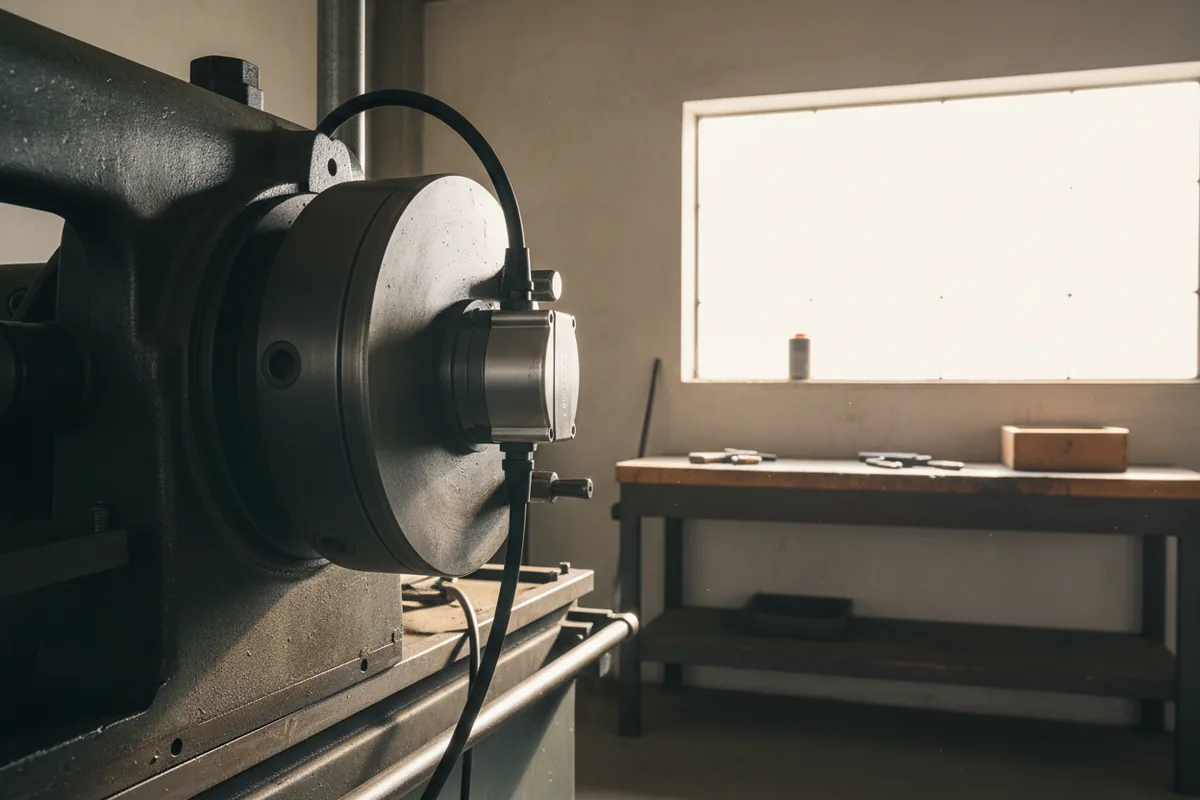
Machine monitoring software collects operating data from production equipment, such as machine state, cycle counts, downtime events, energy draw and process parameters, in or near real time. It then presents that data as dashboards, alerts and reports. Operators, maintenance teams and managers use it to see what each machine is doing and why it stopped.
On this page
- What Machine Monitoring Software Collects and Where It Sits
- How Monitoring Data Moves Through a Manufacturing Operation
- Connectivity, Protocols, and What Your Equipment Must Support
- Deployment Models and Integration Points Compared
- What Drives the Cost and Complexity of a Monitoring Project
- How to Evaluate Machine Monitoring Software for a Facility
- Frequently asked questions
- Sources
What Machine Monitoring Software Collects and Where It Sits
Machine monitoring software is a category of software that gathers operational data from production equipment and makes it available for analysis, alerting or reporting. It observes machines. It does not command them.
The core data types are:
- Machine state: whether a machine is running, idle or faulted.
- Cycle counts: how many parts or cycles a machine has completed.
- Downtime events: when a machine stopped and, where an operator or a signal records it, why.
- Energy draw: the power a machine consumes over time.
- Process parameters: values such as temperature, pressure or spindle load that the control or a sensor reports.
The category sits beside several systems with different jobs:
- SCADA (supervisory control and data acquisition): a system that monitors and controls industrial processes and can send commands to equipment.
- MES (manufacturing execution system): software that manages and records production on the shop floor, including work orders, routing and genealogy.
- CMMS (computerized maintenance management system): software that schedules, tracks and records maintenance work.
- ERP (enterprise resource planning): the business system that handles orders, inventory, purchasing and finance.
Monitoring platforms typically report against OEE (Overall Equipment Effectiveness). OEE is a single measure of how productively a machine runs compared with its theoretical maximum. It is the product of availability (the share of planned time the machine actually ran), performance (actual speed compared with ideal speed) and quality (good parts as a share of total parts). IIoT (Industrial Internet of Things) platforms overlap with this category but extend into broader device management and data infrastructure.
How Monitoring Data Moves Through a Manufacturing Operation
Data typically follows one path. It starts at a machine or sensor, passes through an edge device or gateway, which is a small computer near the equipment that reads and forwards the data, and reaches the software platform. The platform then sends it to a dashboard or an alert, and from there to the person who acts on it.
Each role uses the same data for a different decision:
- Floor operators respond to alerts that a machine has stopped or drifted.
- Maintenance teams trace downtime events to their root cause.
- Operations managers follow OEE trends across shifts, lines and sites.
- Engineering studies process parameters to improve a process.
Monitoring data can also flow to the systems around it. Upstream, production counts and machine states can feed an MES or ERP for production reporting. Downstream, a fault or a condition threshold can create a work order in a CMMS. Whether a connection like this exists depends on each system's interfaces and on the integration work scoped for the project. No single integration pattern applies to every plant.
Reactive and Predictive Monitoring
Monitoring comes in two broad forms. Reactive monitoring raises an alert when a fault or a stop has already happened. Predictive or condition-based monitoring tracks trends in signals such as vibration, temperature or current draw, so that a developing problem can be found before the machine fails.
Predictive approaches need more data history and more analysis to be useful. In practice, that means the signals have to be collected consistently over a period long enough to show what normal operation looks like for each machine, so that a drift away from normal can be told apart from ordinary variation. It also means someone, or some part of the platform, has to interpret those trends and decide what change in a signal is worth acting on. Signals such as vibration and temperature often come from added sensors rather than the machine's own control, which ties the predictive path back to the connectivity and retrofit questions. For this reason, many projects start reactive and add condition-based monitoring once a baseline exists.
Connectivity, Protocols, and What Your Equipment Must Support
Each machine's control system and ports determine what the software can read, so this part of scoping usually takes the most time.
Two open communication standards come up in most scoping conversations:
- MTConnect: an open, read-only standard for CNC machines and other machine tools. It lets software read data from a machine without controlling it. It is a standard, not a product. Whether a given machine supports it depends on that machine's control and options.
- OPC UA (OPC Unified Architecture): a platform-independent, service-oriented framework for exchanging data between machines and between machines and software in industrial automation.
Other connectivity paths include:
- Direct PLC integration: reading data from a PLC (programmable logic controller), the industrial computer that runs a machine's logic, over Ethernet or a serial connection.
- External sensors: current clamps, vibration sensors or vision systems added to a machine that has no native protocol.
- Edge gateways: devices that translate proprietary protocols into a format the monitoring software can read.
Older equipment creates the legacy machine problem. A machine without a network port or a supported protocol needs a hardware retrofit, such as a sensor or a gateway, before any software can monitor it. No protocol is universal, so the machine builder's documentation for each control confirms what that control supports. Wiring and installation belong to the equipment maker's instructions and the qualified people doing the work.
Connecting production equipment to a network also raises security questions. NIST's SP 800-82 Rev. 3, Guide to Operational Technology (OT) Security, published in September 2023, provides guidance on securing OT "while addressing their unique performance, reliability, and safety requirements." NIST describes OT as programmable systems and devices that interact with the physical environment, and its examples include industrial control systems. According to NIST, the document gives an overview of OT and typical system topologies, identifies common threats and vulnerabilities, and recommends security countermeasures. It is voluntary guidance, not a mandate. NIST's page also lists an initial public draft of Revision 4.
Deployment Models and Integration Points Compared
Three deployment models cover most options:
- On-premises: the software runs on plant servers, and the data stays on site.
- Cloud: data goes to vendor-hosted infrastructure, and users reach it through a browser.
- Hybrid: an edge device on site processes the data, and analytics and storage run in the cloud.
| Consideration | On-premises | Cloud | Hybrid |
|---|---|---|---|
| Latency | Data stays on the local network | Depends on the connection to the hosted service | Local edge processing handles time-sensitive data |
| IT infrastructure burden | The plant hosts, patches and backs up the servers | The vendor hosts the infrastructure | Split between on-site edge devices and the vendor |
| Data sovereignty | Data remains on site | Data is stored in vendor-hosted infrastructure | Raw data can stay local while selected data goes to the cloud |
| Cost structure | Usually a license plus internal hosting and support | Usually a recurring subscription | A mix of edge hardware and a subscription |
No model is better for every plant. The right fit depends on the plant's network, its IT and OT policies, and where the data needs to be used.
Integration depth is a separate question from deployment. A monitoring platform that writes data to an MES or ERP needs an API (application programming interface) or a middleware layer. In plain terms, that is a defined agreement about what data the two systems exchange, in what format and when. CMMS integration is a frequent requirement when maintenance drives the project. Once the two systems are connected, monitoring events can create work orders automatically.
Small and medium-sized manufacturers can also look to NIST's Manufacturing Extension Partnership. NIST describes the MEP National Network as a public-private partnership that helps these manufacturers grow, make operational improvements and reduce risk. It is a resource, not an endorsement of any platform.
What Drives the Cost and Complexity of a Monitoring Project
The written quote reflects several factors:
- Number of machines monitored: each connected asset adds licensing, connection and configuration scope.
- Connectivity method: machines with a native protocol cost less to connect than machines that need a hardware retrofit.
- Deployment model: a cloud subscription and an on-premises license produce different cost patterns over time.
- Integration scope: a standalone platform has less scope than one connected to an MES, ERP or CMMS.
- Ongoing support and calibration: added sensors may need periodic calibration, and the platform needs support after go-live.
Hardware retrofits on legacy machines add upfront cost and project time that a software-only quote does not capture. Integration with an existing MES or ERP adds its own scoping, development and testing work, which is separate from the platform license. A quote that lists only licenses leaves these items out.
Security hardening adds scope whenever production equipment goes onto a network. That work includes network segmentation (separating plant networks from business networks), access controls and patch management for connected devices, the areas the NIST OT guidance addresses. Who carries out each task is something each proposal states.
Total cost of ownership (TCO) is the full lifecycle cost of a system, including hardware, software, integration, training and ongoing support. TCO gives a fair basis for comparing a low-license, high-integration offer against the reverse. The gap between a software price and a TCO figure is often widest on mixed, older fleets.
How to Evaluate Machine Monitoring Software for a Facility
Evaluation is easier when every vendor answers the same questions in the same order.
Step 1: Check connectivity fit
Ask whether the platform supports the protocols the machines expose, such as MTConnect, OPC UA or direct PLC drivers. Ask which machines would need sensors or gateways, and who supplies them.
Step 2: Confirm integration depth
Ask which APIs or prebuilt connectors exist for the plant's MES, ERP or CMMS. Ask what integration work falls outside the license.
Step 3: Test deployment model alignment
Ask whether the vendor's architecture fits the plant's IT and OT environment, including network segmentation, remote access policy and where data may be stored.
Step 4: Clarify the vendor support model
Ask what commissioning, training and ongoing support include, and who supports retrofit hardware after installation.
An RFQ (request for quotation) or RFP (request for proposal) produces comparable answers when it includes three documents:
- Machine inventory: list make, model, control type and existing network connectivity for each machine.
- System list: name every system the platform must integrate with.
- Data needs: describe the data the operation needs to act on, and who acts on it.
The MEP National Network can help small and medium-sized manufacturers scope technology projects. NIST's MEP page states that any manufacturer can use the services of MEP Centers, located across the U.S. and in Puerto Rico, and that those services include cybersecurity.
A buyer's first document is usually the machine inventory with its connectivity map. That one record shows which platforms are technically feasible before any vendor conversation begins.
Independent referral
Your next project deserves a clearer starting point.
Describe your requirements. Where there is a fit, we may introduce you to relevant providers.
Industrial Technology Exchange
How the independent referral process works
- DescribeSubmit a short inquiry describing your project, facility and timeline.
- ReviewWe review the inquiry for clarity and fit. Incomplete or out-of-scope requests may not be referred.
- ConnectWith your consent, relevant third-party providers may contact you. You decide whether to engage.
Testimonials
Frequently asked questions
What is a machine monitoring system?
A machine monitoring system combines hardware, such as sensors, gateways or a machine's native interface, with software that collects operating data and makes it available for analysis, alerting and reporting. A control system commands machines. A monitoring system observes them.
What data does machine monitoring software collect?
It collects machine state (running, idle, faulted), cycle counts, downtime events, energy consumption and process parameters such as temperature or pressure. A platform can collect only what the machine's control system or attached sensors can expose.
What is OEE and how does machine monitoring software calculate it?
OEE (Overall Equipment Effectiveness) is the product of availability, performance and quality. It shows how productively a machine runs compared with its theoretical maximum. Monitoring software calculates it from the machine state and cycle data it collects, so the result is only as accurate and complete as that data.
What is MTConnect and which machines support it?
MTConnect is an open, read-only standard for CNC machines and other machine tools. It lets software read machine data without controlling the machine. Support depends on each machine's control system and options, which the machine builder's documentation confirms.
How does machine monitoring software connect to older equipment without a network port?
It connects through a hardware retrofit. External sensors such as current clamps, vibration sensors or I/O modules feed an edge gateway, and the gateway translates the signals into a format the software can read. This adds hardware cost and installation scope that a software-only quote does not include.
How does machine monitoring software differ from SCADA?
SCADA systems both monitor and control industrial processes, and they can send commands to equipment. Machine monitoring software is typically read-only, though some platforms blur this line. The difference matters for OT security and change management.
What is the difference between cloud and on-premises machine monitoring?
On-premises keeps data on plant servers. Cloud sends data to vendor-hosted infrastructure that users reach through a browser. The two differ in latency, IT burden, data sovereignty and cost structure, and neither is better for every plant.
How does machine monitoring software integrate with a MES or ERP?
Integration needs an API or a middleware layer, which defines the data the two systems exchange. Integration depth differs from platform to platform. The integration work is a separate cost and schedule item from the platform license.
What security considerations apply when connecting production machines to a monitoring network?
Connecting equipment to a network raises OT security questions, including network segmentation, access controls and patch management for connected devices. NIST SP 800-82 Rev. 3 offers voluntary guidance on securing OT. No system on its own makes a plant secure.
How to track a manufacturing process with machine monitoring software?
Tracking starts by defining the data points that represent the process, such as machine state, cycle time and reject counts. Next, the team confirms each machine can expose those points through a supported protocol or a sensor. A platform then collects and displays them, and a baseline comes before any trend is read.