

For a plant engineer, a controls engineer, an operations manager or a procurement lead, the open questions are practical. What will the platform connect to? What has to stay inside the control system? Which hosting models will the facility's security policy allow? How can proposals from different suppliers be compared on equal terms? The answers depend on the equipment already on the floor and the outcome expected from the data. A wider smart factory program can follow later; the platform choice comes first.
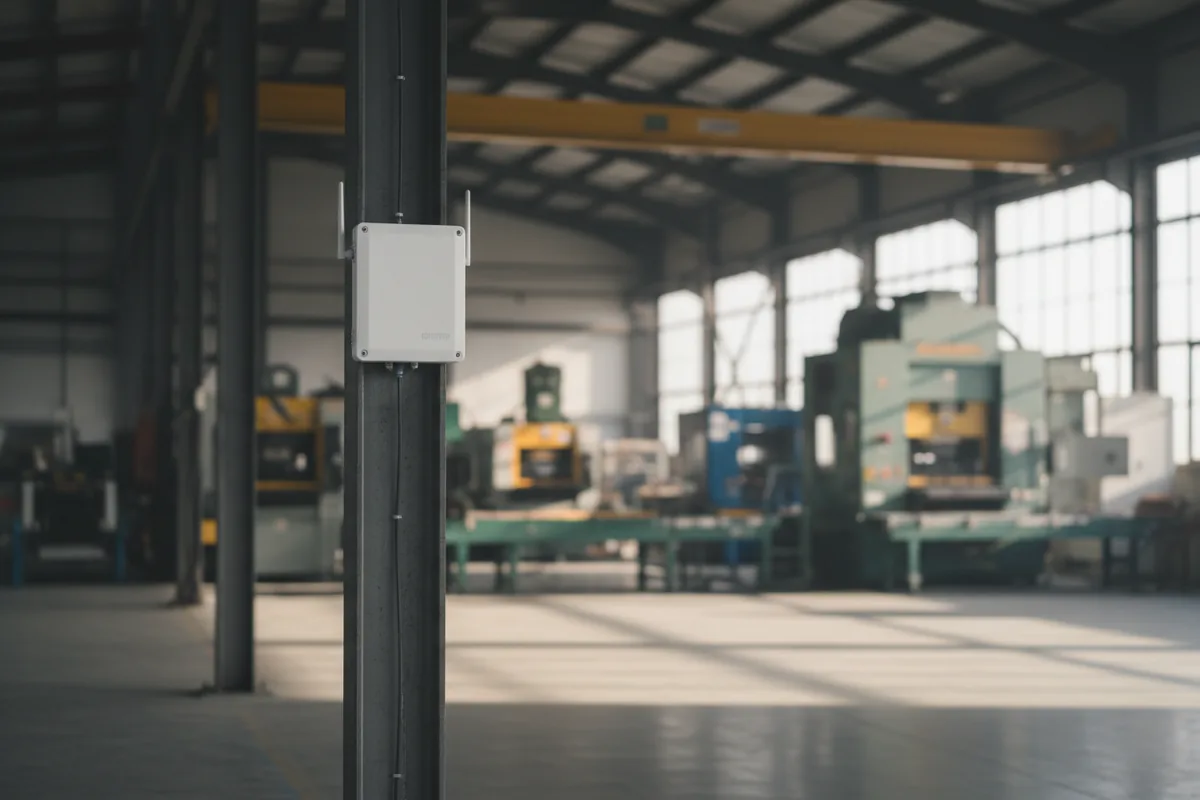
For anyone scoping a plant connectivity project, an industrial IoT platform is software that collects data from controllers, sensors and supervisory systems, translates it into a consistent format, and makes it available for monitoring, analytics, MES and ERP. Real-time control typically stays in the control layer.
On this page
- What an Industrial IoT Platform Does on the Plant Floor
- How an IIoT Platform Fits Into a Plant's Existing Systems
- Operational Requirements and Constraints to Assess Before Selecting a Platform
- OT Security Considerations for Industrial IoT Deployments
- Platform Deployment Models and Architecture Options
- Key Evaluation Criteria When Comparing IIoT Platforms
- What to Prepare Before Requesting Proposals
- Frequently asked questions
- Sources
What an Industrial IoT Platform Does on the Plant Floor
IIoT stands for the Industrial Internet of Things. The term describes networked sensors, machines and software in industrial settings that exchange data with each other and with business systems. Consumer IoT covers products such as smart home devices. Industrial work brings in operational technology (OT), meaning the programmable systems that monitor or control physical equipment and processes.
In a plant, OT includes several kinds of equipment:
- PLCs. A programmable logic controller is the industrial computer that runs a machine's control logic.
- HMIs. A human-machine interface is the screen an operator uses to view and adjust a machine.
- SCADA. Supervisory control and data acquisition systems monitor and supervise processes across a line or a site.
- Sensors and actuators. These are the devices that measure conditions and move equipment.
An IIoT platform connects these OT sources to IT systems and to edge or cloud computing. Its core functions are the following:
- Device connectivity. It links to controllers, sensors and gateways.
- Data ingestion. It pulls in values continuously or on events.
- Normalization. It gives data from different machines the same names, units and context.
- Analytics or visualization. It provides dashboards, alerts and trend analysis.
- Upstream integration. It feeds a manufacturing execution system (MES), which manages and tracks production on the floor, and enterprise resource planning (ERP) software, which runs orders, inventory and finance.
Edge computing processes data at or near the machine. Cloud processing collects data in remote data centers, where readings from several lines or sites can be combined.
How an IIoT Platform Fits Into a Plant's Existing Systems
A layered reference model is the usual way to picture where the platform sits. Field devices and sensors make up the bottom layer. Control systems, including PLCs, SCADA and DCS (distributed control systems, which run continuous processes), sit above them. Manufacturing operations systems such as MES come next, and enterprise systems such as ERP sit at the top. The IIoT platform typically sits between the control layer and the operations and enterprise layers. It reads from the systems below it and serves the systems above it.
Two protocols come up repeatedly in platform discussions:
- OPC UA. OPC Unified Architecture is a vendor-neutral protocol for exchanging structured data between controllers, devices and software. It supports security features and data models that describe what each value means.
- MQTT. MQTT is a lightweight publish-and-subscribe messaging protocol. Devices send messages to a central broker, and other systems subscribe to the topics they need.
Older equipment may speak neither protocol. It may use a serial or proprietary interface, or it may have no network port at all. In those cases, a protocol translation gateway or an edge device converts the machine's signals before the data can reach the platform. On a mixed-age floor, that translation work often sets the scope of a project more than the platform software does.
Operational Requirements and Constraints to Assess Before Selecting a Platform
A plant's equipment and policies set the limits that any platform has to work within. These points are typically assessed before products are evaluated:
- Connectivity. Count the assets to be connected and list the protocols already in use, such as Modbus, EtherNet/IP, PROFINET or OPC UA. This count also shows how many machines fall into the gateway category described earlier.
- Latency. Closed-loop control, where a controller reacts to a sensor within its own scan cycle, stays in the PLC or SCADA layer. In most architectures, IIoT platforms handle monitoring, analytics and reporting, not real-time control.
- Data volume and historian. Estimate how much data each line generates per shift. Check whether a plant historian, a database that stores time-stamped process values, is already in place, and how a candidate platform stores and queries time-series data.
- Security posture. Record the current segmentation between OT and IT networks. Find out whether a platform would need inbound firewall rules, and how it manages credentials and access.
- Deployment model. Confirm whether the facility's IT and OT policies permit cloud hosting, on-premises hosting or a hybrid of the two.
These constraints narrow the field before any demonstration. A platform that cannot work within a plant's latency, protocol or hosting limits will not fit that plant, whatever its feature list.
OT Security Considerations for Industrial IoT Deployments
OT security means protecting the systems that control physical processes, including PLCs, HMIs, SCADA, DCS and sensors, from unauthorized access and disruption. An IIoT platform enlarges the attack surface because it connects OT networks that may have been isolated to IT networks and cloud services. Each new connection creates a possible entry point, which is why security usually belongs early in the conversation with suppliers rather than at the end.
NIST's SP 800-82 Rev. 3, Guide to Operational Technology (OT) Security was published in September 2023 and supersedes SP 800-82 Rev. 2. NIST has also released an initial public draft of Revision 4 for comment. NIST describes Rev. 3 as guidance on securing OT while addressing OT's unique performance, reliability and safety requirements. According to NIST, the document covers three things:
- an overview of OT and typical system topologies;
- common threats and vulnerabilities to these systems;
- recommended security countermeasures to reduce the associated risks.
During selection, these practices work as topics to raise with each supplier. They describe what to ask about, not outcomes any platform delivers on its own:
- Network segmentation. How would the platform sit within separate OT and IT zones, with a demilitarized zone (DMZ) between them?
- Least-privilege access. Can each user and device be limited to the access its role needs?
- Patch management. What process does the supplier follow for updating platform components and gateways?
- Logging and monitoring. What records does the platform keep of who connected, when, and what changed?
Following any of these practices does not by itself bring a facility into line with a NIST document or make it safe. The facility's own security policy and the people responsible for it decide how they apply.
Platform Deployment Models and Architecture Options
The main architectures differ in where processing happens and whether data leaves the plant network. No single model fits every facility.
| Model | Where processing runs | Data leaves the plant? | Where it tends to be considered |
|---|---|---|---|
| Cloud-hosted | The vendor's infrastructure | Yes | Combining data across sites and remote analytics |
| On-premises | Inside the facility's own network | No | Where data location, air-gap rules or OT/IT policy prohibit cloud traffic |
| Hybrid | Edge nodes filter locally, and summarized data goes to the cloud | Partly | Plants with limited bandwidth or latency-sensitive processes |
| Edge-first | At the machine or line, with the cloud optional or absent | Optional | Quality or energy monitoring that has to run without cloud dependency |
Each model carries a trade-off. Cloud hosting moves infrastructure work to the vendor but sends data outside the plant. On-premises hosting keeps data inside the facility but makes the plant responsible for the servers. Hybrid and edge-first designs add more devices on the floor, and each one needs to be maintained.
To assess risk the same way across these choices, an organization can use NIST's Cybersecurity Framework (CSF) 2.0. NIST presents it as a framework "for industry, government, and organizations to reduce cybersecurity risks," and offers Quick Start Guides and profiles to go with it. CSF 2.0 is voluntary guidance, not a compliance requirement.
Key Evaluation Criteria When Comparing IIoT Platforms
When several suppliers answer the same questions in writing, their proposals become much easier to compare side by side. The criteria below tend to cover the ground a plant team cares about:
- Connector library. The first concern is usually whether the platform already speaks the floor's protocols and equipment, or whether connecting them would mean custom development.
- Data modeling. Mixed equipment produces mixed data. Some platforms impose a fixed data model; others allow flexible schemas, and the difference matters once older and newer machines feed the same dashboards.
- MES, ERP and CMMS integration. A CMMS (computerized maintenance management system) tracks work orders and asset maintenance. The useful questions here are which APIs or pre-built connectors exist for these systems, and how much of the integration work would fall on the plant's IT team.
- Security architecture. Teams typically want to understand how the platform authenticates devices and users, and how it encrypts data in transit and at rest. Just as important is the vendor's shared-responsibility model: what the vendor takes on, and what stays with the plant.
- Growth from pilot. A single-line pilot can look very different from a full plant or several sites. Asking what changes in licensing, infrastructure or architecture at that point avoids surprises later.
- Open standards and continuity. Support for OPC UA and MQTT, compared with proprietary interfaces, affects how portable a deployment is. A related question is what would happen to the deployment if the product were acquired or discontinued.
- Total cost of ownership. TCO is the full cost over the platform's life. It covers the licensing or subscription model, connectivity hardware, integration labor and ongoing support. The supplier's written proposal states each of these.
What to Prepare Before Requesting Proposals
An RFQ (request for quotation) or RFP (request for proposal) produces comparable answers only when every supplier receives the same facts. Five documents supply those facts.
Step 1: Build an asset inventory
List each connected and to-be-connected machine with its controller, its communication protocol and its age or generation. The inventory shows suppliers where gateways will be needed.
Step 2: Define the use case
Name the operational problem the platform is meant to solve, such as condition monitoring, energy management, OEE (overall equipment effectiveness) tracking, predictive maintenance or quality data collection. Describe what success would look like in measurable operational terms.
Step 3: Draw the IT/OT network diagram
Show the current segmentation, the firewall rules, and any existing historian or SCADA data flows. Suppliers need this diagram to explain how their platform would connect.
Step 4: Write the integration requirements
List the systems the platform must exchange data with, such as MES, ERP or CMMS. State what data each system needs and how often.
Step 5: Gather security and policy requirements
Collect the facility's own IT/OT security policy, any requirements specific to the industry, such as defense, food safety or pharmaceutical work, and the deployment models that policy permits.
The asset and protocol inventory, read together with the written use-case definition, is the document set that makes platform proposals comparable. Finding out who holds the current network diagram and the security policy is often the first practical task.
Independent referral
Your next project deserves a clearer starting point.
Describe your requirements. Where there is a fit, we may introduce you to relevant providers.
Industrial Technology Exchange
How the independent referral process works
- DescribeSubmit a short inquiry describing your project, facility and timeline.
- ReviewWe review the inquiry for clarity and fit. Incomplete or out-of-scope requests may not be referred.
- ConnectWith your consent, relevant third-party providers may contact you. You decide whether to engage.
Testimonials
Frequently asked questions
What is an example of an industrial IoT platform?
Industrial IoT platforms fall into broad categories rather than one product type. A connectivity-focused platform gathers machine data from PLCs and sensors. An analytics-focused platform adds visualization and anomaly detection on top of that data. A full-stack platform combines connectivity, storage, analytics and integration with business systems.
What is the difference between IIoT and IoT?
IIoT refers to connected devices and software in industrial settings, such as PLCs, sensors and SCADA systems. In those settings, reliability, latency and OT security carry more weight than in consumer IoT, which covers products such as smart home devices. The difference shapes the choice of protocols, the security design and the integration work.
What does an industrial IoT platform connect to in a plant?
It reads from field devices, sensors, PLCs, SCADA and DCS systems, and it serves MES and ERP systems further up. Newer controllers can often link directly over OPC UA or MQTT, while legacy machines usually need a translating device in between, so the mix of equipment ages on a floor largely determines how much connection work a project involves.
How does an industrial IoT platform relate to SCADA?
The two systems work together rather than replace each other. SCADA handles real-time supervision and control of processes. An IIoT platform typically sits above SCADA and takes in its data for longer-term analytics, reporting and comparisons across sites.
What security risks does an industrial IoT platform introduce?
Connecting OT to IT networks and cloud services expands the attack surface. The main risks are unauthorized access to control systems, interception of data, and attackers moving from IT networks into OT networks. NIST's SP 800-82 Rev. 3 addresses OT threats and countermeasures, and its CSF 2.0 offers a voluntary way to structure risk management. Neither document removes these risks.
What is the difference between edge computing and cloud computing in an IIoT platform?
Edge processing keeps data on site and reduces latency and bandwidth use; cloud processing combines data from many sources for wider analytics and remote access. Many architectures use both, with the balance set by latency needs, data volume, bandwidth and the facility's security policy.
Does an industrial IoT platform replace a plant historian?
Not necessarily. A historian stores high-resolution, time-stamped process data. An IIoT platform may read from the historian, add analytics on top of it, or take over some of its uses in certain architectures. The platform's data model and the facility's data retention and access needs determine which arrangement applies.
What is OPC UA and why does it matter for IIoT platforms?
OPC UA, or OPC Unified Architecture, is a vendor-neutral protocol for exchanging structured data between controllers, devices and software. Beyond moving values, it carries data models that describe what each value means, so a platform receives context along with the reading, and it includes security features. A platform that supports OPC UA can connect to equipment that also supports it without a custom protocol adapter for each machine.