

A plant engineer, a maintenance manager or a procurement lead comparing these systems is usually trying to settle a few things: what the software actually replaces, how it connects to the systems already on the floor, and what to ask each vendor. The honest answer is that those questions turn on the plant's own assets, records and existing software far more than on any feature list. What follows takes each part of the decision in the order a buyer usually runs into it.
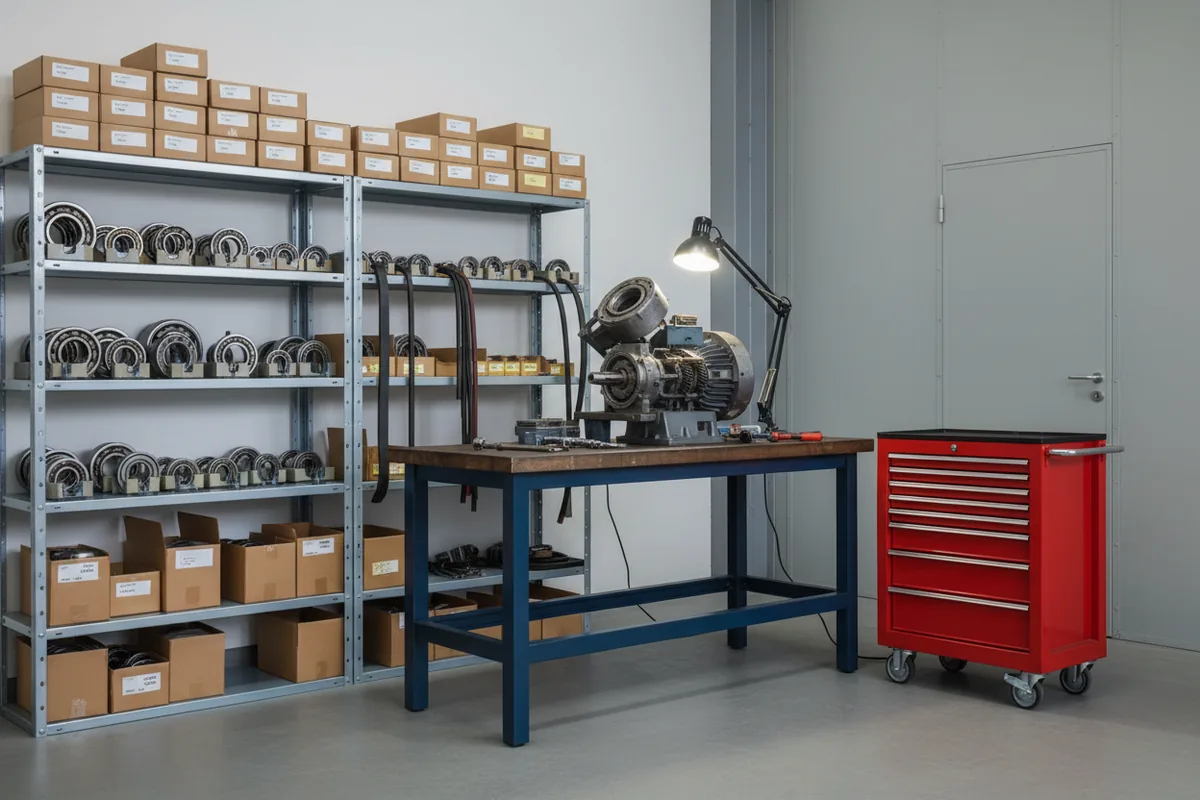
CMMS software, short for Computerized Maintenance Management System, is the application a plant uses to run its maintenance work in one place. It holds work orders, equipment records, preventive maintenance schedules, spare parts inventory and the service history of each asset. It manages maintenance. It does not run production scheduling or financial accounting.
On this page
- What CMMS Software Does and How It Differs From ERP, MES and EAM
- How a CMMS Changes Day-to-Day Plant Maintenance
- Lockout/Tagout and the Maintenance Records a CMMS Can Hold
- Cloud and On-Premises Deployment and the Integrations Behind Them
- Criteria for Comparing CMMS Options
- Starting Points for Small and Medium-Sized Manufacturers
- Frequently asked questions
- Sources
What CMMS Software Does and How It Differs From ERP, MES and EAM
Think of a CMMS as the maintenance department's shared memory. A request becomes a work order, the work order points to a machine, and once the job is done it adds to that machine's history while the parts used come out of a tracked stock. Paper logs, spreadsheets and whiteboards give way to records that a supervisor, a technician and a planner can all see at once.
Three neighboring software categories cause the most confusion during evaluation:
- ERP (enterprise resource planning): the business system for finance, purchasing, inventory valuation, sales and often human resources. An ERP may hold maintenance data, but its center of gravity is the company's books and supply chain.
- MES (manufacturing execution system): the system that directs and records production on the floor, such as orders, routings, material use and output. It tracks what is being made, while a CMMS tracks the condition and care of the equipment doing the making.
- EAM (enterprise asset management): a broader category that covers an asset's whole life, from acquisition through retirement, often across many sites. EAM includes CMMS functions. A CMMS is the maintenance-specific subset.
A CMMS is deployed in one of two ways. Cloud-hosted, or SaaS (software as a service), means the vendor runs the software on its own servers and the plant reaches it through a browser or a mobile app under a subscription. On-premises means the software is installed on servers the facility or the company owns and manages. Each model carries different trade-offs for the operation.
How a CMMS Changes Day-to-Day Plant Maintenance
Work order management is the core workflow. A request is created by an operator, a supervisor or a scheduled trigger. It is assigned to a technician or a crew, tracked while the work is open, and closed with notes on labor, parts and findings.
Preventive maintenance (PM) scheduling generates routine service automatically. Calendar-based triggers issue work at set intervals. Meter-based triggers issue work when a usage reading, such as run hours or cycles, crosses a threshold the plant defines.
The asset register is the equipment list behind everything else: each machine's identity and location, its nameplate data and attached documents such as manuals, drawings and procedures.
MRO (maintenance, repair and operations) inventory covers the spare parts and supplies maintenance consumes, such as bearings, belts, filters and fasteners. The CMMS records stock on hand, where it sits and what each work order used, so reorder points reflect actual consumption.
Reporting turns those records into maintenance measures:
- MTBF (mean time between failures): the average running time between breakdowns of an asset.
- MTTR (mean time to repair): the average time taken to restore an asset after a failure.
- Planned maintenance percentage: the share of maintenance hours spent on scheduled work rather than reactive repairs.
A CMMS rarely stands alone. It typically exchanges purchasing and accounting data with the ERP. It can also take condition data from the floor's control layer. A PLC (programmable logic controller) is the industrial computer that controls a machine. SCADA (supervisory control and data acquisition) is the software that monitors and supervises controllers and processes across a line or a site. Predictive maintenance, which forecasts failures from that kind of data, reaches beyond a standard CMMS scope.
Lockout/Tagout and the Maintenance Records a CMMS Can Hold
Maintenance work sits under a specific federal safety standard, and it is worth knowing what that standard covers before deciding what the software should store. Under 29 C.F.R. § 1910.147, OSHA's standard on the control of hazardous energy (lockout/tagout), the rule "covers the servicing and maintenance of machines and equipment in which the unexpected energization or start up of the machines or equipment, or release of stored energy could cause injury to employees," and it "establishes minimum performance requirements for the control of such hazardous energy."
In its purpose statement, the section says it "requires employers to establish a program and utilize procedures for affixing appropriate lockout devices or tagout devices to energy isolating devices, and to otherwise disable machines or equipment to prevent unexpected energization, start-up or release of stored energy in order to prevent injury to employees." Not every kind of work falls under it. The standard lists exclusions, including construction and agriculture employment and oil and gas well drilling and servicing. Normal production operations are also excluded, though the standard sets out defined conditions under which servicing during production is covered. Those scope and application conditions are spelled out in the full text of 29 C.F.R. § 1910.147.
OSHA's Control of Hazardous Energy (Lockout/Tagout) page states that employers are required to train each worker so they know, understand and are able to follow the applicable provisions of the hazardous energy control procedures. The same OSHA page notes that hazardous energy control is also addressed in other OSHA standards for maritime, construction and certain general industry work. More broadly, 29 U.S.C. § 654 states that each employer "shall comply with occupational safety and health standards promulgated under this chapter."
Where the software fits is narrower than it might first appear. A CMMS can store lockout/tagout procedures and equipment-specific energy-control documents next to each asset, attach them to the work orders where they apply and keep the maintenance history. It does not make a plant compliant or safe. That rests on the program, the procedures, the training and the practice the employer puts in place, and OSHA and the employer's own qualified safety personnel decide how the standard applies to a given machine. Step-by-step lockout methods belong to those procedures, not to software selection.
Cloud and On-Premises Deployment and the Integrations Behind Them
The deployment model shapes cost structure, IT workload and access. Here is how each model generally works.
| Consideration | Cloud-hosted (SaaS) | On-premises |
|---|---|---|
| Where the software runs | Vendor's servers | Facility or company servers |
| How it is paid for | Ongoing subscription | Software license, plus the plant's own hardware |
| Upfront infrastructure | Little in-house server infrastructure | Servers, backup and security handled in-house |
| Updates and upkeep | Vendor applies updates | Company IT schedules and applies updates |
| Control over data and network | Set by the vendor's contract | Held by company IT |
| Access | Browser or mobile app | Internal network, with remote access as IT allows it |
Mobile access matters for technicians. It lets them receive work orders on the floor, look up parts and stock locations, and log time and notes at the machine instead of at a desk.
ERP integration usually handles purchasing and inventory. Parts requests in the CMMS can become purchase orders in the ERP, and receipts and costs flow back so both systems agree on stock and spend.
Condition data is the second integration path. IIoT (Industrial Internet of Things) refers to networked sensors and devices that report equipment readings, such as vibration, temperature or run hours. Data from IIoT sensors, SCADA or PLCs can feed condition-based triggers that open a work order when a reading crosses a limit. Each connection to the control layer also raises network and security questions for the plant's operational technology staff.
Data migration is typically the largest setup task. Building the asset register from paper files, spreadsheets or a legacy system takes the most effort. Setup effort grows with the number of assets, the quality and consistency of existing records, and the number and complexity of integrations. The vendor's proposal describes its own implementation plan.
Criteria for Comparing CMMS Options
Vendor demonstrations tend to show a system at its most polished. A short, consistent set of questions brings the conversation back to the plant's own requirements, and each answer ultimately comes from the vendor's documentation, proposal and contract.
- Functional fit. Can the system handle the plant's asset types, its work order volumes and the complexity of its PM schedules, including meter-based triggers?
- Single-site versus multi-site support. If the company runs several facilities, can one deployment hold them all, with shared or separate asset registers and inventories?
- Mobile capability. Do technicians get a native iOS or Android app or a mobile browser, and what still works without a network connection?
- Integration APIs. What connectors or interfaces exist for the ERP, SCADA or IIoT platforms already in place, and who builds and maintains each one?
- Reporting and configurability. Does the system calculate MTBF, MTTR and planned maintenance percentage the way the maintenance team defines them?
- Vendor support model. What do the vendor's contract terms say about implementation assistance, training and ongoing support?
- Total cost of ownership (TCO). This is the full cost of the system over its life: subscription or license fees, implementation, training, integration development and ongoing support. The vendor's written proposal states those figures.
- Data ownership and export. If the contract ends, what happens to asset and work order records, in what format can they be exported, and on what terms?
The differences usually surface when every vendor works through the same scenarios, such as one real asset, one PM schedule and one parts request. A general demonstration tends to hide what those side-by-side runs reveal, and the ranking that results reflects the plant's own requirements rather than anyone else's.
Starting Points for Small and Medium-Sized Manufacturers
Smaller facilities often start with part of a CMMS. Work orders and a basic asset register usually come first, and PM scheduling and MRO inventory modules follow once the asset records are dependable. Staging it this way keeps the first phase within the team's capacity and gives the plant a chance to check data quality before automated schedules depend on it.
Smaller manufacturers also do not have to work through that kind of change alone. NIST's Manufacturing Extension Partnership page describes the MEP National Network as a public-private partnership that helps small and medium-sized manufacturers grow, make operational improvements and reduce risk. According to the same NIST page, any manufacturer can use the services of MEP Centers, which are located across the U.S. and in Puerto Rico. Their consulting and training are described as tailored to each manufacturer's challenges, with examples running from leadership training and value stream mapping to cybersecurity, along with support for manufacturers learning about or implementing Industry 4.0 technologies.
A useful next step is gathering the facility's current maintenance records, its asset list and a sense of the monthly work order volume the team handles. Those inputs show which system tier is realistic, and they give a vendor's proposal something concrete to answer.
Independent referral
Your next project deserves a clearer starting point.
Describe your requirements. Where there is a fit, we may introduce you to relevant providers.
Industrial Technology Exchange
How the independent referral process works
- DescribeSubmit a short inquiry describing your project, facility and timeline.
- ReviewWe review the inquiry for clarity and fit. Incomplete or out-of-scope requests may not be referred.
- ConnectWith your consent, relevant third-party providers may contact you. You decide whether to engage.
Testimonials
Frequently asked questions
What is CMMS software?
CMMS software is a Computerized Maintenance Management System: the single place where a maintenance team plans, performs and records its work from shared data rather than from paper logs or spreadsheets.
What is the full form of CMMS?
CMMS stands for Computerized Maintenance Management System. The word "computerized" marks the shift from paper and whiteboard tracking to a shared digital record for the maintenance department.
What are the most common CMMS systems?
The category spans a wide range of platforms. Some are single-site tools sized for smaller facilities, and others are multi-site systems with broader asset management functions. Fit comes from the plant's asset count, integration needs and preferred deployment model, and each vendor's own documentation states its capabilities.
How does a CMMS differ from an ERP system?
A CMMS is built around equipment and the work done on it. An ERP system covers the wider business, including finance, procurement, production, human resources and supply chain. Many facilities run both, with the CMMS passing purchase requests or inventory data to the ERP.
What maintenance records does OSHA require facilities to keep?
Under 29 C.F.R. § 1910.147, employers covered by the standard must establish a program and use procedures to control hazardous energy during servicing and maintenance. OSHA's lockout/tagout page also states that workers must be trained. A CMMS can store those procedures and work records, but compliance comes from the program, the training and the practice.
What does CMMS software cost?
Cost depends on the deployment model (a SaaS subscription or an on-premises license), the number of users and assets, the modules activated, integration complexity and support terms. The vendor's written proposal states the figures.