You may be a plant engineer scoping a new line, an operations manager deciding whether to buy a whole line or assemble one from parts, or a procurement lead drafting an RFQ (request for quotation, the document suppliers price against). The real decision is less about the machines than about who carries which responsibility: the supplier, an integrator or your own engineering staff. What follows covers what a turnkey contract usually includes, what stays with the plant, which federal safety rules apply to the equipment, and how the turnkey model compares with the other ways U.S. manufacturers procure a line.
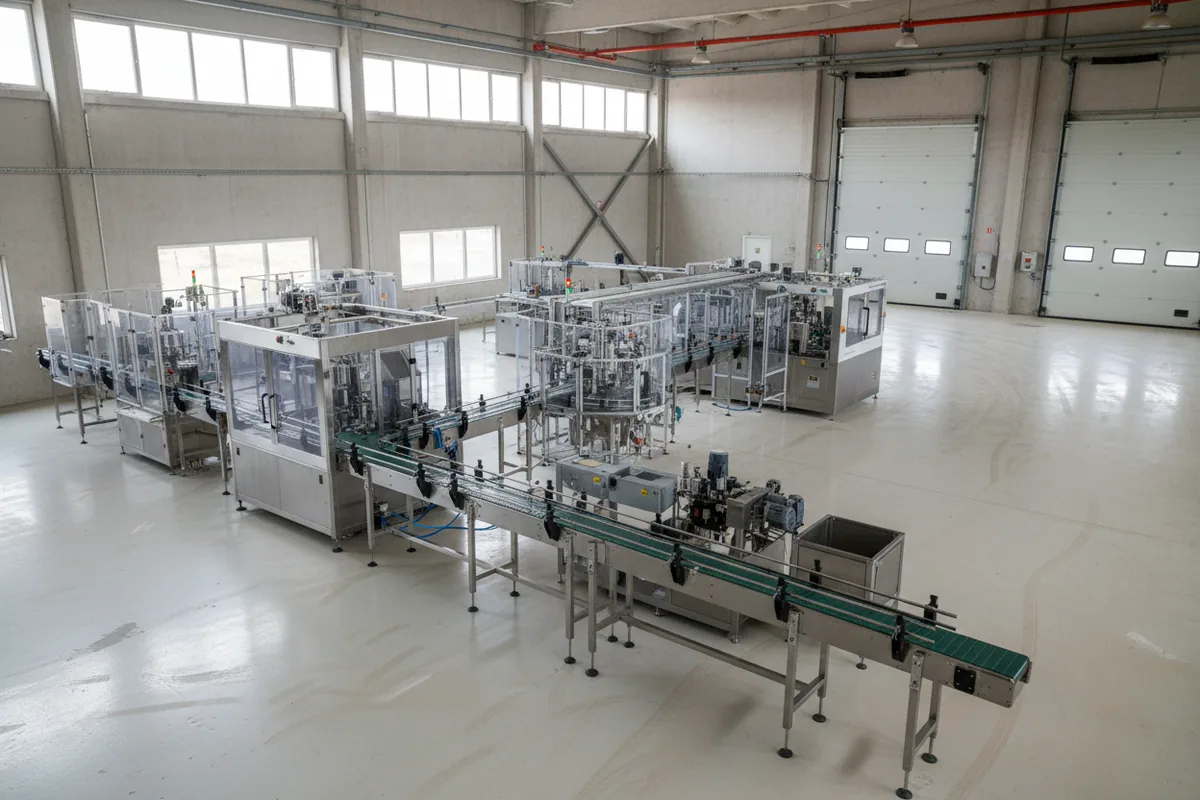
A turnkey production line is a complete manufacturing line that one supplier designs, builds, integrates and commissions under a single contract, then hands over ready to operate. The buyer specifies what the line must produce and how it connects to the plant. The supplier delivers the working system, and the written contract defines exactly what is included.
On this page
- What a Turnkey Production Line Includes and How It Differs From Other Contracts
- What a Turnkey Contract Means for Your Operation
- Federal Safety Rules That Apply to Production Line Machinery
- Comparing Turnkey Supply With Other Ways to Procure a Line
- What Drives Cost and Project Risk in a Turnkey Line
- Writing the Specification and RFQ a Turnkey Line Is Priced Against
- How to Evaluate Turnkey Production Line Suppliers
- Frequently asked questions
- Sources
What a Turnkey Production Line Includes and How It Differs From Other Contracts
What sets turnkey apart is where the hand-off happens. Under other contract types, responsibility passes back and forth between buyer and vendors during the project; under a turnkey contract, it stays with one supplier until commissioning (the startup and proving of the installed line) is complete. A production line, for reference, is the sequence of machines, workstations or processes a product moves through in order, from raw material or sub-assembly to finished output.
The typical scope elements are these:
- Mechanical equipment: the machines, fixtures, conveyors and handling that perform each operation.
- Controls: the PLC (programmable logic controller, the industrial computer that runs machine logic), the HMI (human-machine interface, the operator screen) and, where applicable, SCADA (supervisory control and data acquisition, software that monitors and controls equipment across a line or site).
- Safety guarding: the physical and electronic protection around hazardous parts of the machines.
- Software integration: the connections that let the line exchange data with plant systems.
- Installation and commissioning: setting the line in place and bringing it into production.
Three other contract types sit beside turnkey:
- Component procurement: the buyer purchases machines separately and integrates them.
- Engineering-only or design-build: a firm designs, or designs and builds, part of the system while the buyer keeps other responsibilities.
- Partial-line upgrade: a section of an existing line is replaced or added.
"Turnkey" has no single industry-standard definition. Scope varies by supplier, and the written contract governs what is and is not included.
What a Turnkey Contract Means for Your Operation
Single-point accountability is the core trade. With one supplier owning design, integration and commissioning, there are fewer coordination gaps between vendors. The flip side is dependency: schedule, technical knowledge and support all run through one company.
Some prerequisites stay with the plant, because a supplier cannot provide them on its own:
- Facility readiness: foundations, access and the condition of the building where the line will sit.
- Utility supply: the power, compressed air, water or other utilities the line draws.
- Floor space: room for the line, material flow and maintenance access.
- Network and controls infrastructure: the plant networks and control systems the line must connect to.
- Acceptance-testing capability: people who can judge whether the delivered line meets the specification.
Integration with existing systems is its own scope item. An MES (manufacturing execution system) tracks and directs production on the floor; an ERP (enterprise resource planning) system handles orders, inventory and finance; a CMMS (computerized maintenance management system) schedules and records maintenance. Each connection to these systems, or to an existing SCADA layer, is specified in the contract rather than assumed.
Operator training, maintenance staffing and spare-parts inventory typically remain the buyer's responsibility unless the contract states otherwise. A turnkey handover delivers equipment; it does not by itself make a plant compliant or safe.
Federal Safety Rules That Apply to Production Line Machinery
The starting point is the employer's general duty. Under 29 U.S.C. § 654, each employer must furnish employment and a place of employment free from recognized hazards that are causing or are likely to cause death or serious physical harm to employees, and must comply with occupational safety and health standards promulgated under that chapter. Two of those standards bear directly on the equipment a turnkey line brings into a plant.
Machine guarding. In plain terms, this rule is about keeping people away from the parts of a machine that can hurt them. Under 29 C.F.R. § 1910.212, one or more methods of machine guarding must be provided to protect the operator and other employees in the machine area from hazards such as those created by point of operation, ingoing nip points, rotating parts, flying chips and sparks. The regulation gives barrier guards, two-hand tripping devices and electronic safety devices as examples. Guards are to be affixed to the machine where possible and secured elsewhere if attachment is not possible, and a guard must not offer an accident hazard in itself. The regulation defines the point of operation as the area on a machine where work is actually performed upon the material, and requires it to be guarded on machines whose operation exposes an employee to injury.
Lockout/tagout. This rule is about making sure a machine cannot start up, or release stored energy, while someone is working on it. Under 29 C.F.R. § 1910.147, the standard covers servicing and maintenance of machines and equipment in which unexpected energization or start-up, or release of stored energy, could cause injury to employees, and it establishes minimum performance requirements for controlling that hazardous energy. It excludes certain employment and work, including construction and agriculture employment. Normal production operations are generally not covered, but servicing during normal production is covered only if an employee "is required to remove or bypass a guard or other safety device," or must place any part of the body into the point of operation or an associated danger zone during a machine operating cycle; the regulation sets out an exception for routine minor servicing performed with alternative measures that provide effective protection.
For a turnkey project, the practical question is who holds these duties. A supplier's delivery of guarding and lockout provisions does not by itself settle whether a facility meets these requirements; under the statute that duty sits with the employer, and OSHA determines compliance where it applies. Installation and lockout procedures come from the equipment maker and the employer's own program, never from a buyer guide.
Comparing Turnkey Supply With Other Ways to Procure a Line
Four procurement models line up against five questions a buyer usually weighs: how much the supplier owns, how much integration work lands on the plant, where contract risk sits, how easily the line can change later, and what kind of project each model tends to suit. These are general patterns; a real contract will set its own terms.
| Criterion | Turnkey supply | Component procurement, in-house integration | Design-build with a systems integrator | Modular line expansion |
|---|---|---|---|---|
| Supplier scope | Full line: equipment, controls, integration, commissioning | Individual machines only | Shared; integrator owns controls and software integration | One module or section at a time |
| Buyer integration burden | Lowest | Full | Moderate; buyer selects and buys equipment | Varies with each added module |
| Contract risk | Concentrated in one supplier | Spread across vendors; buyer holds the gaps | Split between buyer and integrator | Spread over several smaller commitments |
| Flexibility | Lower for mid-project changes | Highest | Buyer keeps equipment choice | Incremental by design |
| Project fit | Buyers wanting one accountable party | Buyers with internal engineering capacity | Buyers who want to control equipment selection | Lower upfront commitment; may not suit high-volume greenfield projects |
Each model trades control for convenience in a different proportion. Turnkey reduces the coordination work inside your plant at the cost of dependence on one company; component procurement keeps every decision in-house, and every integration problem there too.
What Drives Cost and Project Risk in a Turnkey Line
The supplier's written proposal or quote states the price, and that price follows from the scope you describe. Put simply, the more the line has to do, the more equipment, controls and protection it needs. The main factors are:
- Throughput and cycle requirements: how much the line must produce and how fast each station must work.
- Number of distinct operations: each added process step adds equipment, controls and guarding.
- Materials and parts handled: part variety, size and material affect tooling and handling.
- Automation level: manual, semi-automated or fully automated stations.
- Controls complexity: PLC count, HMI stations and any SCADA integration.
- Safety guarding scope: the extent of guarding the hazards call for.
- Site conditions: the state of the building, utilities and access.
Budget and schedule overruns tend to come from a different set of causes:
- specifications that are incomplete or still changing at contract signing;
- integration with legacy MES, ERP, SCADA or CMMS systems;
- facility readiness gaps;
- acceptance-test criteria left out of the contract;
- dependence on a single source.
Project timelines follow the same pattern. Because the schedule runs through one supplier, the factors that push cost (scope, integration with existing systems and facility readiness) are also the ones that tend to move the timeline. The proposal and contract state the schedule a given project is held to.
Total cost of ownership (TCO) is the purchase price plus installation, commissioning, training, spare parts, maintenance and eventual modification costs. A lower purchase price can sit alongside higher costs in those later categories.
For smaller plants, NIST describes its Manufacturing Extension Partnership as a public-private partnership that helps small and medium-sized manufacturers grow, make operational improvements and reduce risk, through MEP Centers across the U.S. and in Puerto Rico (NIST MEP). NIST states that any manufacturer can use the services MEP Centers provide; using them is voluntary.
Writing the Specification and RFQ a Turnkey Line Is Priced Against
Suppliers price against the written specification, so the gaps that drive overruns, such as incomplete specifications and missing acceptance criteria, are easiest to close here. A buyer who already has the plant's existing controls platform and system list on paper has the starting material. The specification issued to suppliers typically defines:
- Throughput requirements: the output the line must reach.
- Part and material specifications: every part and material the line will handle.
- Integration points: each named system the line connects to, such as MES, ERP, SCADA or CMMS.
- Safety and regulatory requirements: the guarding and energy-control provisions expected.
- Site constraints: space, utilities and access limits.
- Acceptance-test criteria: the measurable conditions for accepting the line.
How to Evaluate Turnkey Production Line Suppliers
With the specification in hand, technical evaluation usually looks at four things for each supplier:
- its experience with your specific process;
- which scope it performs in-house and which it subcontracts;
- its controls platform, and whether that PLC, HMI and SCADA choice matches your existing infrastructure;
- its documentation standards, including electrical schematics, PLC code and operator manuals.
Contract terms get the same attention: the scope definition of what is and is not included, the change-order process, the acceptance-test protocol, warranty terms, spare-parts availability and post-commissioning support. Warranty length and coverage are set in each supplier's terms rather than by a common standard, so they are compared supplier by supplier. Two tests usually anchor acceptance. Factory acceptance testing (FAT) is testing at the supplier's facility before shipment; site acceptance testing (SAT) is testing at your site after installation.
PLC code and custom software raise a related question. Because the PLC code is part of the documentation a supplier hands over, who holds rights to that code, and to any custom software, is a matter the contract addresses. Where the contract is silent, the plant's later ability to modify or support the line on its own can be unclear.
A turnkey contract does not fit every project. A buyer with strong in-house integration capability and a preference for controlling equipment selection may find that component procurement or a systems-integrator model fits better.
Independent referral
Your next project deserves a clearer starting point.
Describe your requirements. Where there is a fit, we may introduce you to relevant providers.
Industrial Technology Exchange
How the independent referral process works
- DescribeSubmit a short inquiry describing your project, facility and timeline.
- ReviewWe review the inquiry for clarity and fit. Incomplete or out-of-scope requests may not be referred.
- ConnectWith your consent, relevant third-party providers may contact you. You decide whether to engage.
Testimonials
Frequently asked questions
What is a turnkey production line?
A turnkey production line is a complete manufacturing system, covering mechanical equipment, controls, safety guarding and software integration, that one supplier designs, builds and commissions and hands over ready to operate. The written contract defines exactly what is included.
What are turnkey automation solutions?
They are systems where one supplier takes responsibility for design, equipment, controls such as PLC, HMI and SCADA, integration and commissioning. The buyer receives a functioning system rather than assembling components from multiple sources, and scope varies by contract.
What is a production line?
A production line is a sequence of workstations, machines or processes arranged so a product moves through each stage in order, from raw material or sub-assembly to finished output. A turnkey production line delivers that sequence as a single contracted system.
What is an example of an assembly line in a turnkey context?
As a hypothetical, assume a manufacturer needs a sub-assembly line of welding, fastening and inspection stations. Under a turnkey contract, the buyer specifies throughput, part types and integration requirements, and one supplier designs, builds and commissions the full sequence as a single system.
What should a turnkey production line contract include?
It typically defines scope, throughput and cycle requirements, integration points with systems such as MES, ERP and SCADA, safety guarding provisions, FAT and SAT criteria, warranty terms, spare-parts availability and post-commissioning support. Scope the contract does not name is generally outside what the supplier delivers.
What is the difference between a turnkey line and hiring a systems integrator?
A turnkey supplier owns equipment, controls, integration and commissioning under one contract. A systems integrator generally owns controls and software integration while the buyer selects and procures the equipment separately. In-house engineering capacity and the wish to control equipment selection shape which model a buyer chooses.
What OSHA requirements apply to production line machinery?
29 C.F.R. § 1910.212 requires one or more methods of machine guarding to protect operators and others from hazards such as point of operation, ingoing nip points, rotating parts, flying chips and sparks. 29 C.F.R. § 1910.147 covers controlling hazardous energy during servicing and maintenance. The employer carries the duty to comply.
What is total cost of ownership for a production line?
Total cost of ownership is the purchase price plus installation, commissioning, operator training, spare parts, ongoing maintenance and future modification costs. The supplier's written proposal states the purchase price; the other categories follow from how the plant runs and maintains the line.