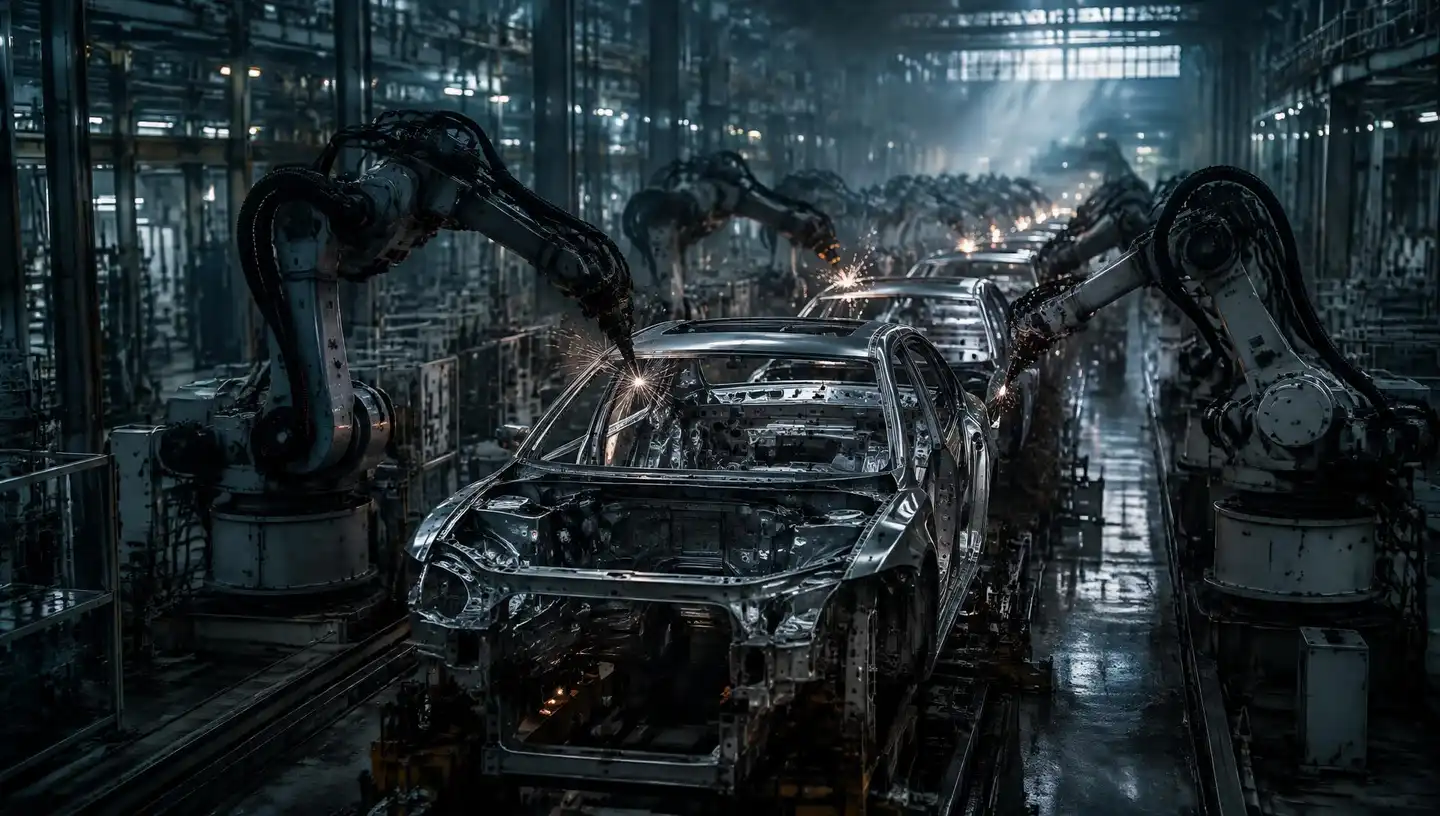
Robotic welding line in an automated automotive body shop

Buying guide · Systems Integration

Manufacturing Systems Integration

Updated November 24, 2026

Gears of different sizes meshing in a machine, separate systems working as one.
Immediate answer

Manufacturing systems integration is the work of connecting a plant's control equipment, such as PLCs, HMIs and SCADA, to the software that runs production and the business, such as MES, ERP and CMMS. Done well, production data moves between those systems automatically, so people stop re-keying counts, orders and quality records from one screen into another.

On this page
  1. Key Points About Manufacturing Systems Integration
  2. Which Operations Manufacturing Systems Integration Fits
  3. How Manufacturing Systems Integration Works
  4. Integration Approaches and How They Differ
  5. How to Evaluate a Manufacturing Systems Integration Provider
  6. What Drives the Cost of a Systems Integration Project
  7. When Manufacturing Systems Integration Is Not the Right Path
  8. Questions to Ask Before Committing to a Systems Integration Project
  9. Frequently asked questions
  10. Sources

You may be a plant engineer, a controls engineer, an operations manager or a procurement lead who has been asked to scope an integration project or write an RFQ, and the scope is still unclear. The questions in front of you are practical ones: which systems connect, which architecture suits the plant, what drives the cost and how to compare integrators without relying on any one vendor's view.

The answers turn on the systems you already run. A plant with networked controllers, a clear data requirement and staff who can support the result is in a different position from one running isolated machines with no network at all.

Key Points About Manufacturing Systems Integration

  • What it is. Manufacturing systems integration links the control layer with the execution and business layers so data flows across the operation without manual re-entry.
  • The terms. A PLC (programmable logic controller) is an industrial computer that runs a machine or process. An HMI (human-machine interface) is the operator's screen. SCADA (supervisory control and data acquisition) monitors and controls processes across a line or site. An MES (manufacturing execution system) manages scheduling, quality and traceability. ERP (enterprise resource planning) handles orders, inventory and finance. A CMMS (computerized maintenance management system) tracks maintenance work. A DCS is a distributed control system.
  • Security guidance. Once control systems are networked to business systems, NIST's SP 800-82 Rev. 3, Guide to Operational Technology (OT) Security becomes relevant to the design.
  • What sets scope. The number of systems, the age of the equipment, the protocols in use and the degree of customization shape each project's scope, complexity and cost.

Which Operations Manufacturing Systems Integration Fits

Integration tends to fit operations where the same data is handled by hand more than once. Typical profiles include:

  • Multi-line or multi-site manufacturers whose production data sits in separate systems that do not share it.
  • Operations where staff transfer counts, scrap or downtime from the shop floor into ERP by hand or by spreadsheet.
  • Facilities adding IIoT (the industrial internet of things, meaning networked sensors and devices that report data) or digital twin capabilities, where a digital twin is a software model of a machine, line or process fed by live data.
  • Plants already upgrading or replacing an MES or ERP, where the new system has to connect to existing controls.

Several signals suggest an operation is ready. PLCs or SCADA are already on a network. The plant has a defined data model, meaning an agreed list of what each data point is called, what it means and where it lives. IT or OT staff can support the connections after the project ends. OT, or operational technology, is the term for the systems that run physical equipment, as distinct from office IT.

Other profiles may not fit yet. A single machine or a very small-batch operation may find manual data collection is enough. A facility with no network infrastructure has groundwork to do before any integration. And a plant whose systems are near the end of their life may find that replacing them is the better path.

Whether integration fits depends on the operation's current systems, its data needs and its capacity to support the result internally.

How Manufacturing Systems Integration Works

Integration spans four layers, running from the floor upward:

  • Field and device layer: sensors, actuators, field devices and PLCs.
  • Supervisory layer: SCADA or a DCS, along with HMIs.
  • Execution layer: MES, handling production scheduling, quality and traceability.
  • Enterprise layer: ERP, handling orders, inventory, finance and the supply chain.

Data moves in both directions. Tags (named data points in a controller, such as a temperature or a part count), events (a stop, a fault, a completed cycle) and transactions travel upward from control systems to MES and ERP. Production orders and schedules travel downward from ERP and MES toward the floor.

The connections themselves use a few common methods. Industrial communication protocols link controllers to higher-level software. REST APIs and message brokers usually carry MES-to-ERP traffic. A REST API is a standard way for one program to request data from another over a network, and a message broker is software that receives messages from one system and delivers them to others. Middleware and integration platforms sit between systems and manage those connections centrally.

CISA's Industrial Control Systems page describes industrial control systems (ICS) and OT as "the systems and devices that interact with the physical environment," and names Critical Manufacturing among the sectors they underpin.

Step 1: Discovery and architecture design

The provider inventories the existing systems, confirms what data must move and drafts the target architecture.

Step 2: Protocol and data mapping

Each data point is mapped from its source to its destination, and protocol differences between systems are identified. Commonly encountered industrial protocols include OPC UA, MQTT, Modbus and EtherNet/IP; a plant may run several of them side by side, and older controllers may use proprietary ones.

Step 3: Development and configuration

Connectors, middleware and interfaces are built or configured to the mapping.

Step 4: Testing in a staging environment

Interfaces are tested away from live production, so that errors surface before they reach the floor.

Step 5: Deployment and handoff

The integration goes live, followed by commissioning, the separate phase in which the installed system is checked out at the site and handed over.

Security where OT meets enterprise networks

Connecting control systems to enterprise networks raises questions of network segmentation, access control and monitoring. NIST's SP 800-82 Rev. 3, published in September 2023, provides guidance on securing OT "while addressing their unique performance, reliability, and safety requirements." NIST's page also notes an initial public draft of Revision 4. Alongside it, NIST describes its Cybersecurity Framework 2.0 as intended "for industry, government, and organizations to reduce cybersecurity risks." Both are voluntary guidance. Neither is a compliance mandate, and following them does not make a plant secure or compliant.

Integration Approaches and How They Differ

The architecture choice sets how the integration behaves as the plant adds systems over time. Each approach generally works as follows.

ApproachHow it connectsTrade-off
Point-to-pointA direct link between two systemsUsually less up-front design; the maintenance burden grows as the number of links grows
Middleware or integration platformA central broker manages all connectionsMore design work at the start; systems added later connect to one place
Cloud or IIoT platformEdge devices send data to a cloud platform that connects to ERP or analyticsDepends on modern networked equipment and IT infrastructure to support it
Packaged connectorsPre-built links that some MES and ERP vendors supply for common pairingsLimited to the pairings and data those connectors cover
Custom developmentInterfaces built for the plant's specific systems and dataNeeded where no connector exists or a connector misses required data; more to document and maintain

Plants often combine these approaches, for example packaged connectors between MES and ERP and custom protocol work for older controllers.

No single approach fits every facility. The suitable architecture depends on the number and age of the systems, the protocols they use, the volume of data and the internal team's ability to maintain what gets built.

How to Evaluate a Manufacturing Systems Integration Provider

The criteria are vendor-neutral. They apply to any integrator, and they produce answers that can be set side by side.

  • Technical capability. Ask which control platforms, SCADA packages, MES products and ERP systems the provider has integrated, which protocols it has worked with, and ask for sample documentation of the data models and protocols it used.
  • Industry experience. Ask whether the provider has worked in your type of manufacturing, such as discrete, process, food and beverage or automotive, and how it handles the quality or traceability data that applies there.
  • Architecture documentation. Ask whether a written architecture document, a data dictionary (a defined list of every data point and its meaning) and interface specifications are contract deliverables, rather than a working system with no record of how it works.
  • OT security approach. Ask how the provider handles network segmentation, access controls and change management, and how that approach lines up with NIST SP 800-82 Rev. 3 and the Cybersecurity Framework 2.0. CISA's Industrial Control Systems page lists role-specific guidance for "Integrators, Engineering Firms" and links a September 23, 2026 fact sheet on how operators can work with third-party ICS integrators on secure practices.
  • Support and ownership. Ask what post-deployment support is included, what the contract's response terms are for integration failures, and who owns the integration code and configuration.
  • References. Ask for references from facilities with a similar integration scope, not general references.
  • On-site safety coordination. Under 29 C.F.R. § 1910.147(f)(2), whenever outside servicing personnel are to do work covered by the lockout/tagout standard, "the on-site employer and the outside employer shall inform each other of their respective lockout or tagout procedures," and the on-site employer shall ensure its employees understand and comply with the outside employer's energy control program. Separately, 29 U.S.C. § 654 requires each employer to comply with the occupational safety and health standards issued under that chapter.

A qualified safety professional or the equipment maker confirms how a given standard applies to a particular installation.

What Drives the Cost of a Systems Integration Project

Scope drives cost. Each of these factors adds or removes work:

  • Number of systems. Each additional system adds discovery, mapping, development and testing.
  • Equipment age and protocol mix. Legacy PLCs and proprietary protocols need extra conversion work. Newer equipment with open communication interfaces usually needs less.
  • Customization. Pre-built connectors between common MES and ERP pairings usually take less work to implement than fully custom interfaces.
  • Data volume and timing. High-frequency collection from many tags raises infrastructure and software licensing needs.
  • OT security scope. Network segmentation, a DMZ between the OT and IT networks (a buffer zone that controls what crosses between them) and monitoring tools each add scope.
  • Internal support capacity. A facility with IT or OT staff who can maintain the integration needs less outside support. One without that capacity needs a managed support arrangement.
  • Testing and validation. Industries with quality or traceability requirements, such as food, pharmaceuticals and automotive, need more rigorous testing and documentation.

Total cost of ownership, meaning the purchase price plus the support, licensing and maintenance over the system's life, is the fuller comparison. The provider's written proposal, built on a current-state system inventory and a defined scope, is the document that states the project's cost.

When Manufacturing Systems Integration Is Not the Right Path

Integration can be premature or unnecessary under these conditions:

  • Systems near end-of-life. Connecting a PLC or SCADA system that is already scheduled for replacement can produce less value than waiting and integrating its replacement.
  • No defined data requirement. When an operation cannot say what data it needs, where that data goes and what decisions it informs, the integration design cannot be scoped accurately.
  • No one to maintain it. An integration that no one on staff can support creates a long-term dependency on outside help. Without funding set aside for that support, the integration degrades.
  • A very small operation. A facility running one line with one PLC and no MES may not need integration. Manual collection or a simple historian, software that records process data over time, may be enough.
  • A budget gap. When the available budget does not cover discovery, architecture, development, testing and support, a phased project or a simpler tool may suit the operation better than a full integration.

A provider that scopes every inquiry as a full integration project, regardless of the facility's actual needs, is not giving an accurate picture of the choices.

Questions to Ask Before Committing to a Systems Integration Project

What data must move, between which systems, and how often? The answer sets the architecture, the data volume and much of the cost.

What is the current state of our PLCs, SCADA, MES and ERP? Software versions, protocols and network topology determine how much conversion work the project needs.

Which systems are due for replacement or upgrade? Integrating a system shortly before it is replaced adds work twice.

Will the provider deliver architecture documentation, a data dictionary and interface specifications? These documents let your own team, or a future provider, maintain what was built.

How will the provider secure the OT network where it meets enterprise systems? The answer shows whether the provider's approach is consistent with the NIST guidance.

What are the support terms, and who owns the code and configuration? Ownership decides whether you can change providers later.

Has the provider integrated our specific combination of control platform, MES and ERP? Experience with the exact pairing reduces discovery work.

What testing and validation records will be delivered? These records need to match the quality or regulatory requirements your operation already works under.

A practical next step is a current-state system inventory listing each PLC, SCADA, MES and ERP system with its software version, the protocols it supports and how it sits on the network. With that inventory attached to an RFQ, providers can scope the same work and their proposals can be compared directly.

Independent referral

Your next project deserves a clearer starting point.

Describe your requirements. Where there is a fit, we may introduce you to relevant providers.

Industrial Technology Exchange

How the independent referral process works

  1. DescribeSubmit a short inquiry describing your project, facility and timeline.
  2. ReviewWe review the inquiry for clarity and fit. Incomplete or out-of-scope requests may not be referred.
  3. ConnectWith your consent, relevant third-party providers may contact you. You decide whether to engage.

Independent referral

Planning a project?

Discuss Your Project

Testimonials

The specs mattered—voltage, fit, lead time—not just finding something that looked similar.

P.C., Albuquerque, NM

Frequently asked questions

What is manufacturing systems integration?

It is the connection of the control layer (PLCs, HMIs, SCADA) with execution and enterprise systems (MES, ERP, CMMS), so production data flows across the operation without manual re-entry.

What is an example of an integrated manufacturing system?

Here is an illustrative example, not a real installation. A discrete manufacturer's SCADA system sends production counts and downtime events to an MES. The MES then sends completed work orders and quality records to the ERP. Production, quality and inventory data then match across all three systems, with no one re-keying them.

What are the basic components of computer-integrated manufacturing (CIM)?

CIM is the idea of connecting every layer of a manufacturing operation: the field and device layer, the supervisory layer, the execution layer and the enterprise layer, as laid out in the description of how integration works. Systems integration is the practical work of building and maintaining the connections between them.

What OT security considerations apply when integrating manufacturing systems?

Connecting PLCs and SCADA to enterprise networks raises questions of segmentation, access control and monitoring. NIST SP 800-82 Rev. 3 is NIST's guidance on securing OT. The Cybersecurity Framework 2.0 is a voluntary framework for managing cybersecurity risk. Neither is a compliance mandate.

What is the difference between SCADA, MES and ERP?

SCADA monitors and controls physical processes in real time on the plant floor. MES manages production execution: scheduling, quality, traceability and work orders. ERP handles business data such as orders, inventory, finance and the supply chain. Integration connects these layers so data flows between them.

How do I know if my facility is ready for a systems integration project?

Readiness signs include: - Networked PLCs or SCADA already in place. - A defined data requirement. - IT or OT staff who can support the integration. - Systems that are not due for near-term replacement. A current-state inventory of systems, versions, protocols and network topology is the practical starting point.

Sources

  1. 01NIST: SP 800-82 Rev. 3, Guide to Operational Technology (OT) Security · csrc.nist.gov
  2. 02NIST: Cybersecurity Framework · nist.gov
  3. 03CISA: Industrial Control Systems · cisa.gov
  4. 0429 C.F.R. § 1910.147, The control of hazardous energy (lockout/tagout)
  5. 0529 U.S.C. § 654, Duties of employers and employees