
A plant engineer or procurement lead scoping machined parts or drafting an RFQ (request for quote, the document that asks suppliers to price a defined scope) has a narrower question than "who can make this." The real question is which supplier can hold the drawing's limits, prove it with measurement records, and document the work at the level the part's end use calls for. The decision turns on process capability, the quality system, measurement traceability, supplier model and the cost drivers a quote reflects.
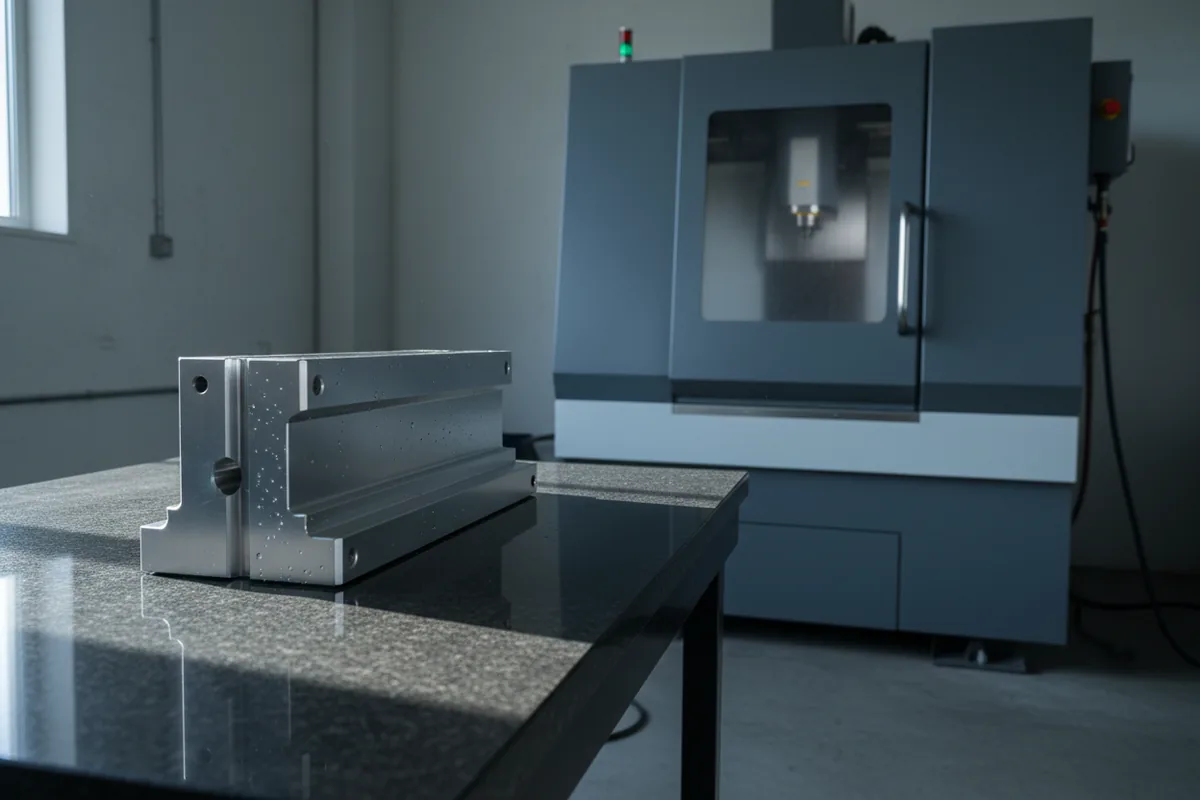
Precision machining services are outside suppliers that cut metal or plastic parts to tight dimensional limits using CNC turning, milling, grinding, electrical discharge machining and related processes. A buyer sends drawings, material and quantity, and the supplier machines, inspects and documents the parts. Buyers choose this work when geometry and tolerances matter more than lowest unit cost.
On this page
- Key Takeaways for Buyers Evaluating Precision Machining
- Which Operations and Industries Precision Machining Fits
- How Precision Machining Works: Processes and Capabilities
- Machining Options and How They Differ
- How to Evaluate a Precision Machining Supplier
- What Drives the Cost of Precision Machining
- When Precision Machining Is Not the Right Fit
- Questions to Ask Before You Issue an RFQ
- Frequently asked questions
- Sources
Key Takeaways for Buyers Evaluating Precision Machining
These points frame the rest of the evaluation:
- Precision machining is a family of processes. Turning, milling, grinding, EDM and related operations remove material to hold tight dimensional tolerances; "precision" describes the tolerance range held, not one machine.
- The parts serve demanding industries. Aerospace, defense, medical devices, semiconductor equipment, energy and general industrial equipment all source machined parts.
- Credentials are checked against documents. Quality system registrations and ITAR status are confirmed with the issuing body rather than taken at face value.
- Measurement traceability carries weight. Metrological traceability links a supplier's measurements to national or international reference standards. NIST's Policy on Metrological Traceability sets out the U.S. National Institute of Standards and Technology's position on the concept.
- A federal resource exists for manufacturers. NIST's Manufacturing Extension Partnership page describes the MEP National Network as a public-private partnership helping small and medium-sized manufacturers grow, make operational improvements and reduce risk.
- The quote, not a published rate, states cost. The supplier's written quote reflects the part's specific requirements.
Which Operations and Industries Precision Machining Fits
Part characteristics decide fit more than industry does. Precision machining suits parts with tight tolerances, complex geometry, low-to-medium volumes, or materials that are hard to cast, stamp or mold. A shaft with ground bearing journals, a manifold with intersecting internal passages, or a bracket with tightly located bores in titanium are the kinds of features machining handles.
Industries that buy machined parts include:
- Aerospace and defense, where supply chains may call for AS9100 quality systems and, for defense articles, ITAR registration.
- Medical devices, where instruments and components carry their own regulatory quality expectations.
- Semiconductor capital equipment, where vacuum, motion and fixture components need controlled dimensions and finishes.
- Energy and power generation, including valve, pump and turbine components.
- Automotive, mainly prototype and low-volume parts.
- General industrial OEMs building machinery, tooling and automation equipment, where machined parts often sit alongside custom machinery and other specialized manufacturing work.
Machining differs from high-volume forming processes. Stamping, casting and injection molding spread a large tooling investment across very large quantities, while machining spends machine time on each part. For very high volumes of simple-geometry parts, machining is typically not the lowest-cost path.
ITAR stands for the International Traffic in Arms Regulations, the federal rules on defense articles. Whether a part falls under ITAR, and what registration a supplier holds, is settled by the U.S. State Department's Directorate of Defense Trade Controls (DDTC), not by a supplier's own statement, so a buyer of defense-related parts confirms that status independently.
How Precision Machining Works: Processes and Capabilities
Each process removes material differently, which is why a supplier's equipment list matters as much as its quality system. Two terms come first. Tolerance is the allowable deviation from a nominal dimension, written on the drawing in thousandths or ten-thousandths of an inch or the metric equivalent. Surface finish is the texture a machined surface is left with, usually measured as Ra, the average roughness.
CNC turning
The workpiece rotates while a stationary cutting tool removes material. Turning produces cylindrical and conical features such as shafts, bushings, pins and threaded ends. CNC (computer numerical control) means the machine follows a programmed tool path rather than manual hand movements.
CNC milling
A rotating cutting tool moves across a workpiece that is held fixed or moved on a table. Milling produces flat faces, slots, pockets, holes and complex three-dimensional contours, and covers much prismatic part work.
Grinding
An abrasive wheel removes small amounts of material to reach fine surface finishes and tight tolerances. Grinding is used on hardened materials, often after heat treatment, where cutting tools are less suited.
Electrical discharge machining (EDM)
EDM removes material through controlled electrical sparks between an electrode and the workpiece. It handles hard, conductive materials and internal shapes, sharp internal corners and narrow slots that a rotating tool cannot reach.
Multi-axis machining
Four-axis and five-axis machines move the tool or part along additional rotary axes. This lets complex parts be machined in fewer setups. Each time a part is unclamped and refixtured, small positioning errors can accumulate, so fewer setups can improve dimensional consistency between features.
Machining Options and How They Differ
Supplier models differ mostly in scope and accountability.
Job shop. A job shop takes individual purchase orders for machined parts and typically handles a wide range of part types and materials. The model suits prototypes and low-to-medium volume work. The trade-off is that assembly, finishing and logistics may remain the buyer's responsibility to coordinate.
Contract manufacturer (CM). A contract manufacturer takes on broader scope under one contract, which may include machining, assembly, finishing and supply chain management. The model suits buyers who want a single point of accountability. The trade-off is less direct visibility into individual process steps and subcontractors.
Vertically integrated supplier. This supplier owns several process steps, such as casting or forging, machining and finishing. Keeping steps in one company can reduce handoffs, lead time and tolerance stack-up (the accumulated variation when parts pass between separate operations and shops). The trade-off is reliance on one company across several processes.
Domestic versus offshore sourcing. Domestic suppliers generally offer easier communication, quicker turnaround on design changes and simpler handling of ITAR and export-controlled work. Offshore suppliers may offer lower piece-part cost for stable, high-volume designs, but add supply chain complexity, longer logistics and intellectual property risk. Export-controlled designs narrow the domestic-versus-offshore choice considerably.
A buyer can also mix models: a job shop for prototypes, then a contract manufacturer or vertically integrated supplier once the design is stable.
How to Evaluate a Precision Machining Supplier
Supplier evaluation rests on evidence the supplier can produce. These criteria cover the main points.
Quality management system. ISO 9001 is the baseline quality management system certification buyers ask about, and AS9100 is the version aerospace and defense supply chains look for. Buyers typically request the certificate itself, its scope (which sites and processes it covers) and the issuing registrar, then confirm with the registrar.
Metrological traceability. The supplier's coordinate measuring machines (CMMs), gauges and instruments are only as trustworthy as their calibration. NIST's Policy on Metrological Traceability describes traceability as a documented, unbroken chain of calibrations linking a measurement to a reference, and places the burden of supporting a traceability claim on the supplier and the burden of assessing it on the buyer. The policy also notes that traceability alone does not show a measurement is fit for purpose, so buyers typically request calibration records and check that measurement uncertainty is small enough for the drawing's tolerances.
Equipment capability. A machine list with axis count, travel and spindle specifications shows whether the supplier has the processes the part needs, such as five-axis milling, EDM or grinding, in-house.
ITAR registration. For defense-related parts, registration status is confirmed with DDTC directly rather than through the supplier's self-declaration.
Capacity. Machine utilization, queue depth and the approach to surge demand indicate whether the supplier can absorb the work.
First article inspection (FAI). An FAI is a documented check that the first production part meets every drawing requirement before the lot runs. Buyers typically ask whether the supplier performs FAI to AS9102 or an equivalent and supplies full dimensional reports.
MEP resources. NIST's MEP page states that any manufacturer can use the services of MEP Centers located across the U.S. and in Puerto Rico, and describes the network's work helping organizations secure domestic suppliers and strengthen supply chain resilience. A small or medium-sized manufacturer can contact its regional MEP Center about supplier development.
What Drives the Cost of Precision Machining
Price reflects machine time, labor, material and documentation, and the supplier's written quote states the actual figure. An RFQ that defines each driver below gets a quote built on the same assumptions from every supplier.
- Material. Aluminum, stainless steel, titanium, Inconel and engineering plastics differ in raw cost and machinability; harder or more abrasive materials call for slower feeds, more tool changes and specialized tooling.
- Tolerance and surface finish. Tighter limits and finer finishes add setups, slower cuts and inspection time.
- Complexity and setups. Geometry that needs several fixturing setups multiplies machine time and labor.
- Lot size. Setup cost is spread across the parts in a lot, so very small lots carry a high per-part setup share.
- Post-machining operations. Heat treatment, anodizing, plating and passivation add cost and may be subcontracted.
- Inspection and documentation. AS9100 or ITAR work and customer requirements such as FAI reports, material certifications and certificates of conformance (COCs) add inspection and paperwork labor.
- Tooling. Custom fixtures or special tools are typically a one-time cost the buyer may be asked to fund, with ownership set in the commercial terms.
Total cost of ownership extends beyond piece price to include scrap, rework, freight, inventory and the cost of a late or nonconforming part reaching assembly.
When Precision Machining Is Not the Right Fit
Some parts belong to another process family. Very high volumes of simple-geometry parts are typically cheaper per part through stamping, casting or injection molding once tooling is amortized. Parts whose dimensions are not critical can often be made to standard commercial tolerances by less capital-intensive processes. Large structural sections, such as frames and weldments, belong to structural fabrication, meaning welding and forming, rather than precision machining.
Buyer priorities also matter. A buyer whose main requirement is the lowest piece-part price on a commodity part, with no quality system or traceability requirement, may find a precision machining supplier's overhead for ISO 9001, calibrated metrology and documentation reflected in its price. A commercial supplier of standard parts may fit that need instead.
Parts in regulated families, such as medical implants or nuclear components, carry their own regulatory frameworks; whether a supplier's quality system scope covers that framework is confirmed against the supplier's certificate scope and the regulator that governs the part.
Questions to Ask Before You Issue an RFQ
These questions cover quality, capability, compliance and commercial terms:
- Certifications. What quality management certifications does the supplier hold, and what is each certificate's scope?
- Traceability. How does the supplier document metrological traceability for its measurement equipment?
- ITAR status. What is the supplier's ITAR registration status, and what documentation can it provide?
- Processes. Which machining processes and axis counts are in-house, and which are subcontracted?
- First article. What is the FAI process, and what documentation comes with it?
- Engineering changes. How are engineering changes handled after a purchase order is placed?
- Lead times. What are the standard lead times for prototype and production quantities, and how does queue depth affect them?
- Finishing. Which finishing, heat treatment or coating operations are in-house, and who owns quality at each subcontracted step?
- Commercial terms. What are the payment terms, minimum order quantities and tooling ownership terms?
The practical next step is assembling the part drawings, tolerance callouts, material specifications and annual volume estimates, since those documents let a supplier answer an RFQ with a meaningful quote.
Independent referral
Your next project deserves a clearer starting point.
Describe your requirements. Where there is a fit, we may introduce you to relevant providers.
Industrial Technology Exchange
How the independent referral process works
- DescribeSubmit a short inquiry describing your project, facility and timeline.
- ReviewWe review the inquiry for clarity and fit. Incomplete or out-of-scope requests may not be referred.
- ConnectWith your consent, relevant third-party providers may contact you. You decide whether to engage.
Testimonials
Frequently asked questions
What is precision machining?
Precision machining is a set of subtractive processes, including CNC turning, milling, grinding and EDM, that remove material from a workpiece to produce parts with tight dimensional tolerances and controlled surface finishes. "Precision" refers to the tolerance range held, not a single process or machine.
What certifications should a precision machining supplier have?
It depends on the part's end use: general industrial work usually starts from ISO 9001, aerospace and defense add AS9100, and defense articles raise ITAR registration with DDTC. In each case the certificate's scope matters as much as the name, and status is confirmed with the issuing body.
What is metrological traceability and why does it matter for machined parts?
NIST's policy defines it as a measurement result related to a reference through a documented unbroken chain of calibrations. It matters because a part's measured conformance is only as reliable as the instruments' calibration. NIST's policy also states that traceability alone does not signify fitness for purpose.
What is a first article inspection (FAI) in precision machining?
An FAI is a documented check that the first production part meets all drawing and specification requirements before the full lot runs. Aerospace supply chains reference AS9102 for it. A buyer typically asks whether the FAI package includes a full dimensional report and material certifications.
What drives the cost of precision machined parts?
The biggest swings usually come from how much machine time and setup a part needs and how much inspection paperwork it carries, which is why small lots and documentation-heavy work price higher per part. The supplier's written quote states the actual cost.
How does the NIST Manufacturing Extension Partnership help manufacturers sourcing precision machining?
NIST's MEP page describes the MEP National Network as helping small and medium-sized manufacturers grow, make operational improvements and reduce risk, and states that any manufacturer can use MEP Center services across the U.S. and Puerto Rico. A manufacturer can contact its regional MEP Center about supplier development.
What is the difference between a job shop and a contract manufacturer for precision machining?
A job shop takes individual purchase orders across many part types and materials, suiting prototype and low-to-medium volume work. A contract manufacturer may combine machining, assembly, finishing and supply chain management under one contract, giving the buyer a single point of accountability.
When is precision machining not the right manufacturing process?
It is typically not the lowest-cost path for very high volumes of simple-geometry parts, where stamping, casting or injection molding apply, and it does not cover large structural fabrication. Commodity parts without quality or traceability requirements may not justify a precision supplier's documentation overhead.