Scoping a digital twin project or drafting an RFQ, whether as a plant engineer, operations manager, controls engineer or procurement lead, raises four practical questions: what the software does, what it has to connect to in the plant, which security questions come with linking a model to live control systems, and which capabilities and cost categories separate one platform from another.
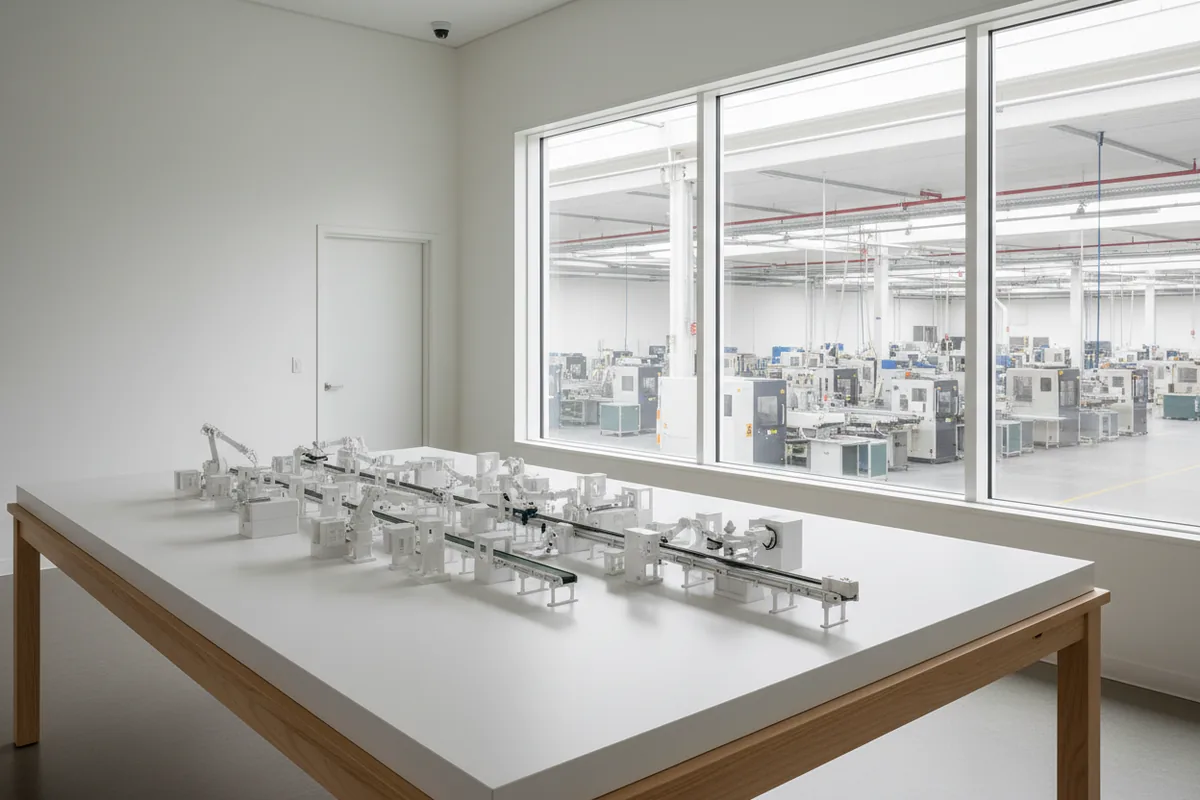
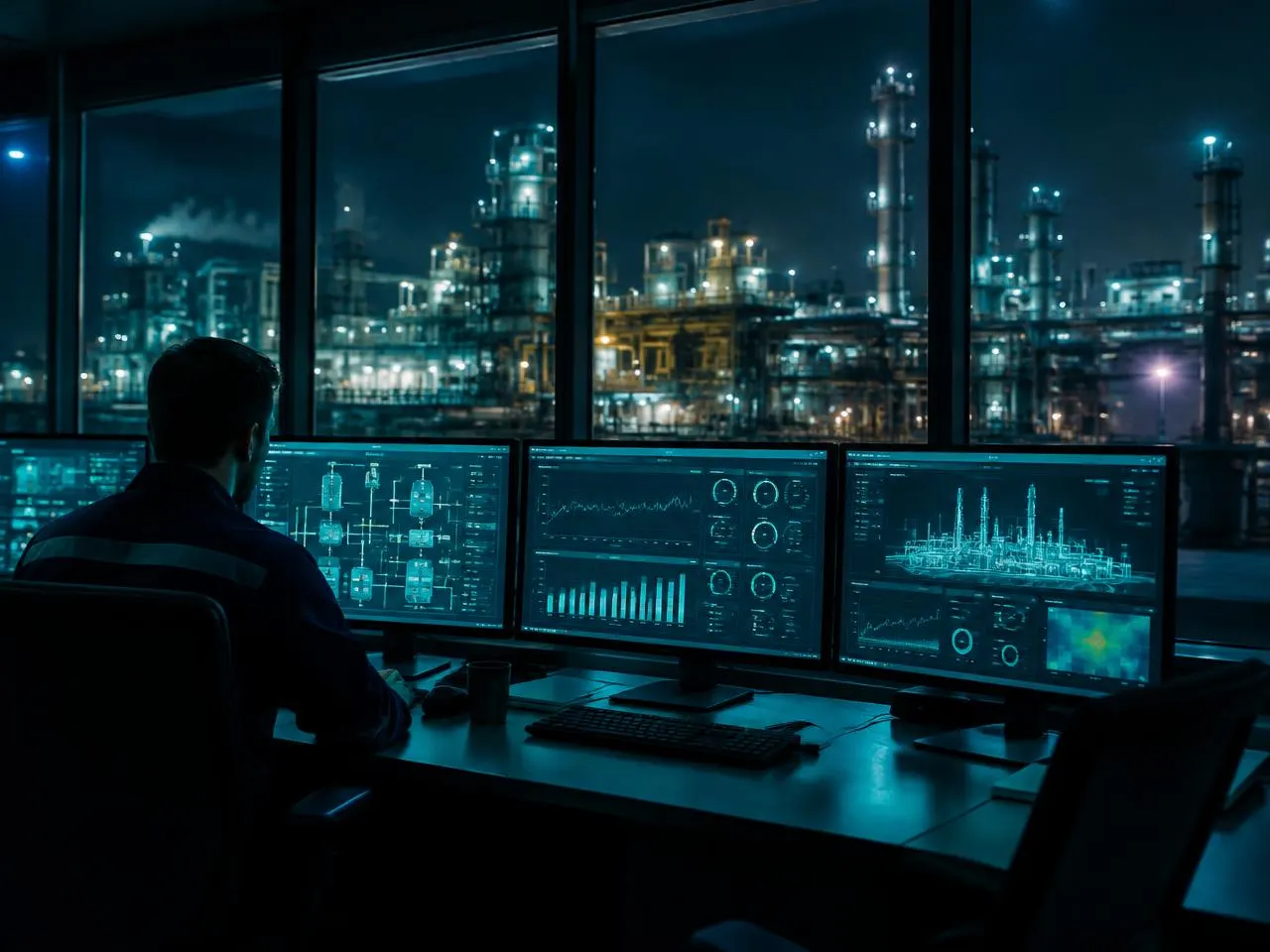
Digital twin software for manufacturing builds and maintains a virtual model of a machine, a production line or a whole plant, kept current by live data from the plant floor. Engineers and operators use that model to monitor equipment, test changes in software before they reach the physical line, and analyze how the operation is running.
On this page
- What Digital Twin Software Does in a Manufacturing Environment
- How a Digital Twin Connects to Plant Operations
- Integration Requirements and Operational Constraints
- Platform Capabilities to Compare When Evaluating Digital Twin Software
- Procurement and Project Scoping Considerations
- Frequently asked questions
- Sources
What Digital Twin Software Does in a Manufacturing Environment
A digital twin is a virtual representation of a physical asset, process or system that is updated from real-world data. A static simulation runs against fixed inputs. A 3D or CAD model describes geometry. A twin is different from both because its state changes as the physical thing changes.
NIST describes the technology in similar terms. According to NIST IR 8356, Security and Trust Considerations for Digital Twin Technology, published in February 2025, digital twin technology enables the creation of electronic representations of real-world entities and the ability to view the states and transitions between states of those entities. NIST says the report covers the concept and purpose of the technology and its characteristics, features, functions and expected operational uses. The report's listed keywords include real-time monitoring, real-time command, simulation, instrumentation and control.
In manufacturing, a twin is usually scoped at one of three levels:
- Asset level: a single machine or component, such as a spindle, a pump or a robot.
- Process level: a production line or a work cell, including how stations interact.
- Facility level: a full plant or factory floor, including equipment, material flow and process parameters.
The data that keeps the twin current comes from the plant's existing systems:
- Sensors measure physical conditions such as temperature, vibration, pressure or position.
- PLCs (programmable logic controllers) are industrial computers that run machine control logic and hold the machine's current state.
- SCADA (supervisory control and data acquisition) systems gather data from controllers across a site and give operators supervisory control.
- MES (manufacturing execution system) software tracks work orders, production and quality on the floor.
- IIoT (industrial Internet of Things) devices are networked sensors and gateways that send equipment data to software platforms.
The software layer does four things. It ingests data from those sources, maintains the model, runs analytics or simulations against it, and surfaces the results to operators or engineers. The model and its data link are the core of the product.
How a Digital Twin Connects to Plant Operations
On the plant floor, the twin's value comes from four uses. Each one depends on the data feeding the model.
Predictive maintenance. Predictive maintenance schedules service based on an asset's measured condition rather than a fixed calendar. A twin supports it by comparing an asset's present state against historical and real-time data and flagging deviation, such as a vibration signature drifting from its normal pattern.
Process optimization. Engineers can run what-if scenarios against the twin before changing physical line parameters. Examples include a different feed rate, a revised sequence or a rebalanced station. The physical line keeps running while the alternatives are tested in software.
Virtual commissioning. Commissioning is the work of testing and starting up new or modified equipment and confirming it operates as designed. With virtual commissioning, PLC logic and control sequences are tested against the digital twin before physical startup, so logic errors can surface before steel and wiring are involved. The controls engineering team and the equipment maker remain responsible for physical startup and its safety procedures.
Operator training. A twin gives operators a place to practice procedures without risk to live equipment. That includes changeovers, fault response and unusual operating conditions.
All four uses share one constraint. A twin's outputs are only as reliable as the sensor data and integration that feed it. A sensor that is poorly calibrated, a dropped connection or a tag mapped to the wrong signal produces a model that looks current but is wrong. Data quality, sensor upkeep and integration testing are therefore part of the project, not an afterthought.
Integration Requirements and Operational Constraints
A twin needs connectivity before it can function. It must connect to operational technology (OT), meaning the hardware and software that monitor and control physical equipment and processes. That includes PLCs, SCADA and HMIs (human-machine interfaces, the screens operators use to view and run a machine). It often connects to IT systems too, such as ERP (enterprise resource planning software for orders, inventory and finance) and CMMS (computerized maintenance management system software for work orders and asset records).
NIST's OT guidance defines the territory a twin connects into. NIST SP 800-82 Rev. 3, Guide to Operational Technology (OT) Security, published in September 2023 and superseding Rev. 2, provides guidance on securing OT while addressing its unique performance, reliability and safety requirements. NIST describes OT as programmable systems and devices that interact with the physical environment, or manage devices that do, through the monitoring and control of devices, processes and events. It lists industrial control systems and building automation systems among its examples. NIST says the guide gives an overview of OT and typical system topologies, identifies common threats and vulnerabilities, and recommends security countermeasures to mitigate the associated risks. Its planning note of September 21, 2026 points to the initial public draft of Revision 4, with public comments due by November 30, 2026. SP 800-82 is voluntary guidance. Following it does not make a plant compliant or safe.
The twin adds its own security questions. NIST IR 8356 discusses both traditional and novel cybersecurity challenges presented by digital twin technology, as well as trust considerations in the context of existing NIST guidance. A model that mirrors live operational data, and may accept commands, is one more system that has to be protected and trusted.
Three constraints shape project complexity:
- Legacy equipment: Machines without native digital outputs may need retrofitted sensors or edge devices. Edge devices are local computers that collect and forward data.
- Network architecture: Connecting a twin to live OT systems raises questions about segmentation between networks, access control and which direction data may flow.
- Data mapping: Signals from different controllers have to be named, scaled and linked to the correct elements of the model.
How a particular plant's network should be designed is a decision for the plant's own controls and security engineers, working from guidance such as SP 800-82.
Platform Capabilities to Compare When Evaluating Digital Twin Software
The criteria that follow describe capability categories, not products. Each vendor's documentation and written proposal state what its platform supports.
Data ingestion. The first question is which industrial protocols the platform reads. OPC-UA (OPC Unified Architecture) is an open, platform-independent standard for exchanging industrial data. MQTT is a lightweight publish-and-subscribe messaging protocol used for IIoT data. Other paths include REST APIs and direct PLC or SCADA connectors.
Model fidelity. Platforms take one of three modeling approaches:
| Approach | What it requires | Where it fits |
|---|---|---|
| Physics-based | Engineering data on the equipment's physical behavior | Assets whose behavior is well understood mechanically or thermally |
| Data-driven (learned from operating data) | A substantial history of operating data | Processes that are hard to model from first principles |
| Hybrid | Both engineering models and operating data | Cases where neither approach alone describes the asset |
Simulation capability. Some platforms run simulation in real time alongside live operations. Others support offline what-if analysis. Some do both.
Visualization and HMI integration. Options include 3D visualization, dashboards and outputs that appear inside existing HMI or SCADA screens, so operators do not have to learn a separate interface.
Scalability. An asset-level twin involves one data source and one model. A plant-level twin adds many sources, interactions between models and more integration. Multi-site deployment adds network, governance and data-consistency questions across locations.
Lock-in and open standards. A platform that stores models in proprietary formats can be harder to leave than one built on open industrial standards.
Deployment model. On-premises software runs inside the plant's network. Cloud software runs on the vendor's or a cloud provider's infrastructure. Hybrid deployments split the work between them. Each choice changes where OT data travels, how the network is segmented and where the data resides.
Procurement and Project Scoping Considerations
Scope drives everything else in a digital twin purchase. The main factors are asset count, process complexity and integration depth. A written scope document that names the assets, data sources and intended uses is the foundation of any RFQ.
An RFQ (request for quotation) asks suppliers to price a defined scope. An RFP (request for proposal) asks them to propose an approach as well. For digital twin software, either document typically addresses:
- Protocol support and the connectors included.
- Deployment model and where the data resides.
- Data ownership, including who owns the models and the operating data.
- Support terms and service levels.
- Upgrade path and version compatibility.
Total cost of ownership (TCO) is the full cost of acquiring and running a system over its life, not just its purchase price. For a twin, the cost categories include licensing or subscription, implementation and integration, sensor or edge hardware where needed, training, and ongoing support. Each supplier's written quote states its own figures.
A systems integrator is a firm that connects equipment, controls and software from different sources into one working system. Many twin deployments involve one for the OT/IT integration work, and the integrator's scope affects total project cost. A buyer comparing quotes can check whether integration is included in the software proposal or priced separately.
Scoping often starts with a pilot or proof of concept on a single asset or line. That tests data quality and integration before the project scales.
For the security review, NIST IR 8356 and NIST SP 800-82 Rev. 3 give a buyer a common reference to raise with each vendor. Both are voluntary guidance, not mandates. A buyer can ask each vendor how its platform addresses the cybersecurity and trust challenges those documents describe.
Independent referral
Your next project deserves a clearer starting point.
Describe your requirements. Where there is a fit, we may introduce you to relevant providers.
Industrial Technology Exchange
How the independent referral process works
- DescribeSubmit a short inquiry describing your project, facility and timeline.
- ReviewWe review the inquiry for clarity and fit. Incomplete or out-of-scope requests may not be referred.
- ConnectWith your consent, relevant third-party providers may contact you. You decide whether to engage.
Testimonials
Frequently asked questions
What are digital twins in manufacturing?
A digital twin in manufacturing is a virtual model of a machine, a line or a facility that is kept current with operating data from sensors, PLCs and control systems. Engineers use it for monitoring, simulation and analysis. NIST IR 8356 describes the technology as creating electronic representations of real-world entities whose states and transitions can be viewed.
What software is used to make digital twins?
Digital twin platforms differ mainly by scope. Some focus on asset-level modeling, while others focus on process or facility simulation. All of them perform four core functions: data ingestion, model maintenance, simulation or analytics, and visualization. Comparing platforms means checking how each one handles those functions for the plant's scope.
What companies make digital twins?
The vendor landscape falls into three broad groups: automation platform vendors, industrial IoT platform vendors and simulation-focused software vendors. Systems integrators often deliver the connection work. A buyer compares any of them on the capabilities and cost categories its RFQ defines, using each vendor's own documentation and proposal.
Can you provide an example of a digital twin factory?
Here is a hypothetical. Assume a plant models its assembly hall, including its equipment, material flow and process parameters, and connects the model to live data. Engineers watch line status, test a layout change in software before moving equipment, and plan maintenance from the condition of each asset. No real facility or results are described.
How does digital twin software connect to existing plant systems?
The twin reads data from PLCs, SCADA and MES through protocols such as OPC-UA or MQTT, through REST APIs or through direct connectors. It may also link to ERP and CMMS. Legacy machines without digital outputs may need retrofitted sensors or edge devices. The plant's controls engineers handle the connection design.
What cybersecurity considerations apply to digital twin software in manufacturing?
The questions fall on two fronts. The twin itself is a new system: NIST IR 8356 covers the cybersecurity and trust challenges specific to digital twin technology. The OT it connects to is the second front, covered by NIST SP 800-82 Rev. 3. In practice, a twin that may accept commands raises questions about network segmentation, access control and which direction data flows. Both NIST documents are voluntary guidance.
How do you evaluate digital twin software for a manufacturing plant?
Evaluation usually starts from scope rather than features: the assets, data sources and intended uses named in a written scope document. Platforms are then compared on how they handle that scope, from protocols and modeling approach to deployment model and data ownership. A pilot on a single asset or line can test data quality and integration before a larger commitment, and each vendor's written proposal answers for its own platform.
What is the difference between a digital twin and a simulation?
A simulation typically runs once or periodically against fixed inputs. A digital twin is updated from live operating data, so it reflects the current state of the asset or process. Many twin platforms include simulation as one of their functions, running what-if scenarios against that current state.